
The milestones investors expect from deep tech startups before a Series A are not the ones a software company reports. Revenue matters, but it rarely arrives first.
What comes first is evidence that the hard part works outside the lab, in conditions someone else controls. Most founders optimize a metric dashboard while the investor looks for that proof.
The five firms below all write checks into science and hardware companies, and each underwrites a different slice of that risk.
What to Look For in a Deep Tech Investor
Before the list, the three things that separate an investor who can price technical and industrial risk from one who will ask for ARR multiples you do not have yet.
📋 What to Look For in a Deep Tech Investor
- ✓Diligence that talks to your customers: The strongest signal an investor can get is operator testimony, not a deck. Ask who they call before they decide.
- ✓Reserves behind the first check: Deep tech rounds are capital hungry. A fund that holds meaningful reserves can follow you through a slipped timeline.
- ✓A thesis that names your layer: Published theses are checkable. A firm that writes about your specific system has already done part of the homework.
The Milestones Deep Tech Investors Expect Before a Series A
The pattern across these five firms is consistent. A deep tech Series A tends to follow a working unit in the field, a customer who will speak on the record, and a costed production plan.
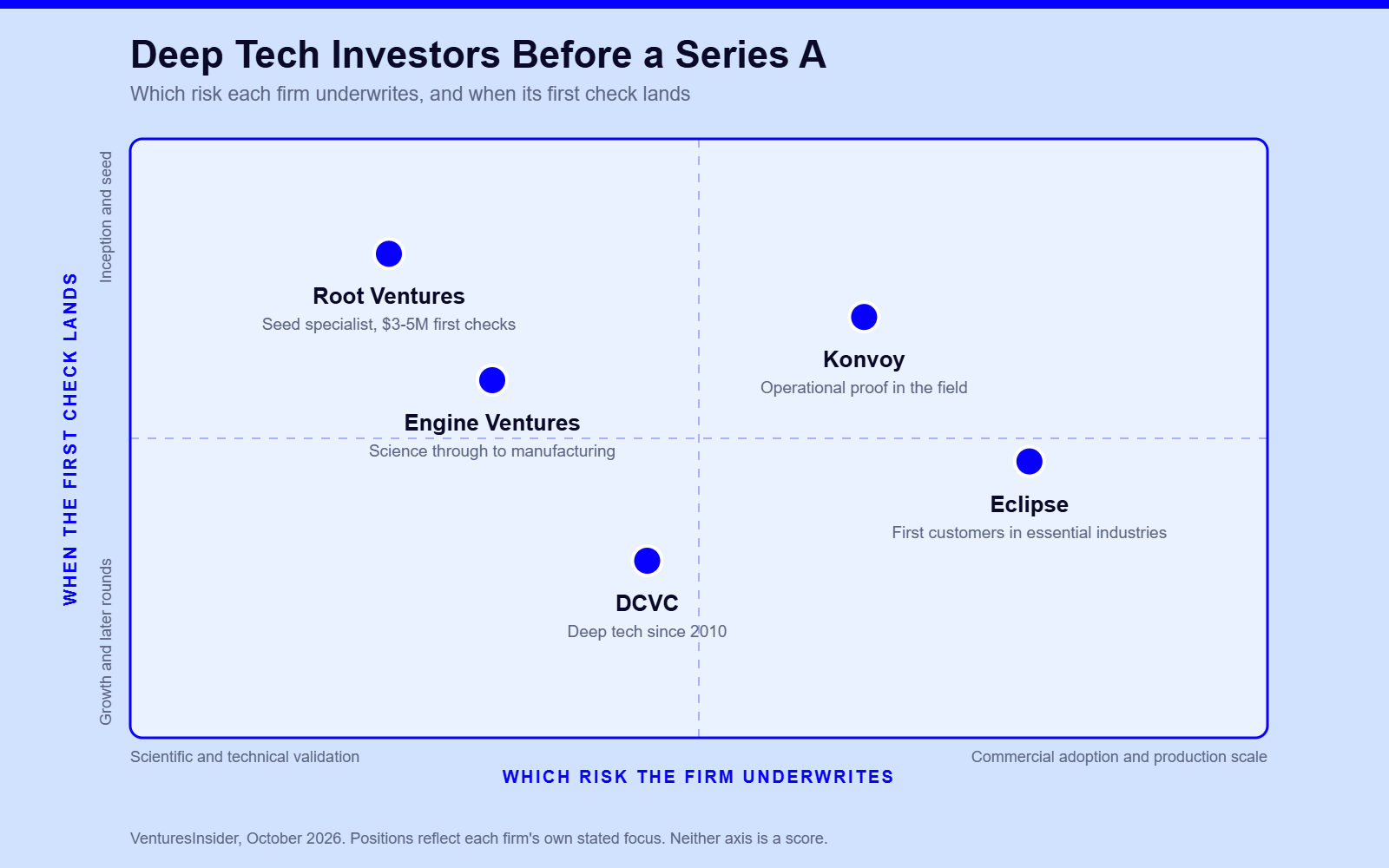
The map places each firm by the risk it underwrites and by when its first check lands. Neither axis is a score: a fund at the bottom right is a different partner, not a weaker one.
| VC Firm | Best For | Why It Stands Out |
|---|---|---|
| 1. Engine Ventures | Science that is still being proven | Backs Tough Tech from early scientific insight through manufacturing and scale, with Commonwealth Fusion Systems and Form Energy on the list. |
| 2. Konvoy | Hardware with proof in the field | Led the $20M Series A for Seasats in February 2026 and ran diligence by calling the company’s own customers. |
| 3. Eclipse | First customers in heavy industry | Built around the physical economy and says plainly that it helps companies reach their first customers and critical milestones. |
| 4. Root Ventures | The seed round before the Series A | A deep tech seed fund that publishes its $3 to $5M initial checks and keeps two thirds of its funds in reserve. |
| 5. DCVC | Long horizon, capital intensive bets | Backing deep tech since 2010, with Fervo Energy carried through to a Nasdaq listing. |
1. Engine Ventures
Engine Ventures describes itself as a venture firm that invests in the next generation of Tough Tech founders. It is the firm on this list most comfortable underwriting science that is not finished yet.
Its partners say they work with teams from early scientific insight and validation through manufacturing, deployment, and scale. That is the whole arc a deep tech company has to walk, stated as one mandate.
The portfolio is the argument: Commonwealth Fusion Systems, Form Energy and Lilac Solutions.
For a pre Series A founder the read is this. Engine expects the scientific risk to be retired at a scale relevant to the real application, not at bench scale.
2. Konvoy
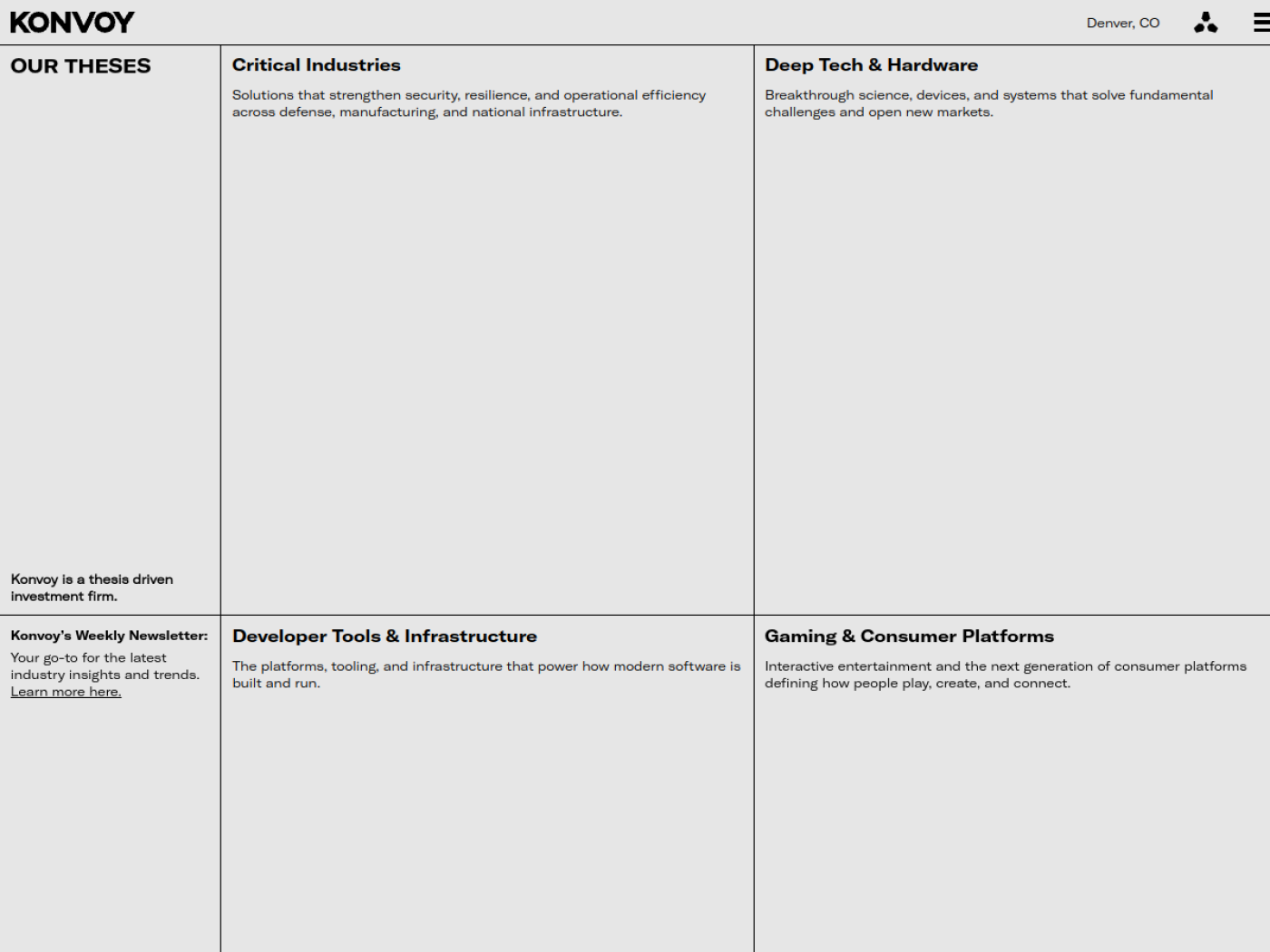
Konvoy is a thesis driven investment firm whose Deep Tech and Hardware thesis covers breakthrough science, devices, and systems that solve fundamental challenges and open new markets.
It is also the firm here that most recently set the terms of a deep tech Series A. In February 2026 Konvoy led the $20 million Series A for Seasats, which builds small uncrewed surface vehicles.
The diligence behind it is what makes the round worth reading. Jason Chapman, co founder and managing partner at Konvoy, said the firm spoke directly with Seasats’ customers.
The milestones Seasats had already cleared are the answer to this article’s question. Its long endurance vessel had completed trans Pacific and trans Atlantic crossings, and the company had won U.S. Marine Corps and U.S. Navy contracts.
It had also been selected for the Department of War’s APFIT program, which funds capabilities that have completed development and are ready to scale, and had booked over $100 million in U.S. government contracts. Proof of operation came before the growth capital, not after it.
The rest of the hardware portfolio shows the same early entry. Konvoy backed Lux Aeterna, a Denver company building a fully reusable satellite fleet, in January 2026, and tscircuit, a code based EDA tool, in September 2025.
Earlier checks include Afference, which creates tactile sensations through neural stimulation in a wearable device.
Konvoy publishes its theses and a weekly newsletter rather than a stage or a check size, so the quickest way to test fit is to read the portfolio before you pitch.
3. Eclipse

Eclipse invests in entrepreneurs building the next generation of companies in the physical economy, and frames its focus as the industries that determine resilience, competitiveness, and security.
Its own language is close to this article’s subject: the firm says it helps companies reach their first customers and critical milestones. That is the Series A hinge stated plainly.
Its companies page lists Wayve, Cerebras Systems and Bedrock Robotics, and calls the group a network rebuilding the infrastructure of the modern physical world.
Founders selling into heavy industry get the most from this one. Its attention sits on sectors that buy slowly and then buy for a decade.
4. Root Ventures
Root Ventures calls itself a San Francisco based deep tech seed fund, and it is the firm on this list that funds the round immediately before the one this article is about.
It publishes what most firms will not. Initial investments typically range from $3 to $5 million, and the firm keeps two thirds of its funds in reserve.
That reserve figure matters more than it looks. It says the fund expects to keep writing checks when a hardware timeline slips.
Root leads initial funding for founders tackling new technical opportunities, so it is often the first institutional money on a cap table.
Its portfolio includes Instrumental, Dusty Robotics and nTopology. Twelve months out from a Series A, this is the conversation that shapes which milestones you aim at.
5. DCVC
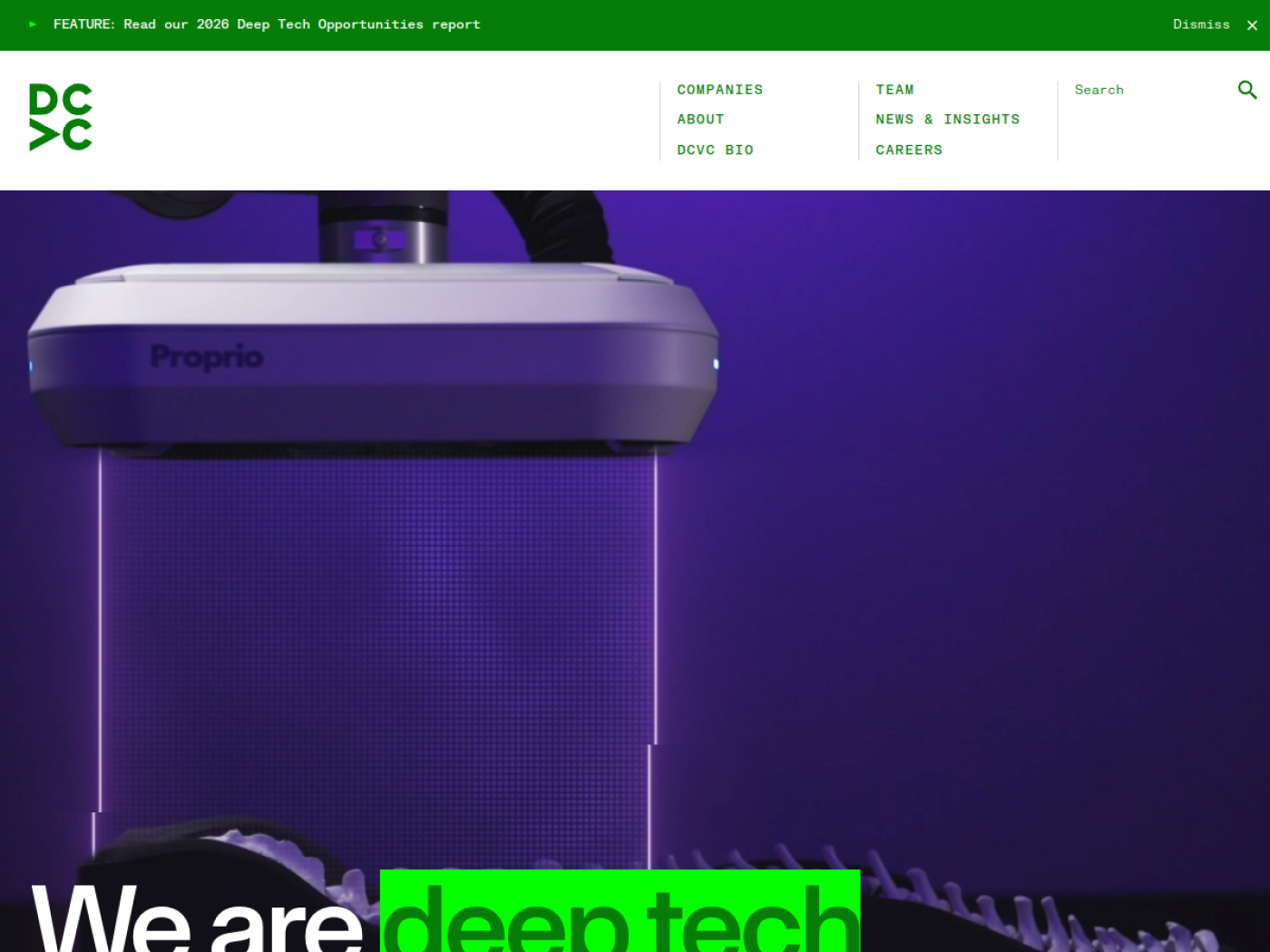
DCVC states its position in four words: we are deep tech venture capital. It has the longest continuous track record of the five.
Since 2010 it has backed entrepreneurs who address the hardest, highest-stakes problems in the world. Sixteen years in one category is its own kind of evidence.
Its spotlight list shows the full distance. Fervo Energy, first backed in 2022, is listed as an exit on Nasdaq, and Pivot Bio dates to 2014.
A fund that has carried companies from first check to public listing has watched many Series A rounds come together. That pattern recognition is the product.
DCVC does not publish a stage either, so treat that spotlight list as the filter. Every figure on this page was verified against each firm’s own site in October 2026.
In Summary
The honest answer is proof that is external to you. A demo you control counts for less than a deployment someone else paid for.
The Seasats round is the cleanest example here. Ocean crossings, Navy and Marine Corps contracts and a program selection came first, and the $20 million came after.
Each firm weights that evidence differently. Engine goes earlier on science, Root funds the stage before, Eclipse looks for first customers, and DCVC brings sixteen years of pattern recognition.
Konvoy sits where published thesis and recent activity meet, with hardware checks dated from 2022 through 2026 and a Series A it led this year.
Pick the firm whose stated mandate names your layer, then work backward from the milestones it has actually funded.
For deeper lists see our guides to investors who fund early-stage deep tech companies and the best venture capital firms investing in deep tech startups.
Founders selling into defense and national infrastructure should also read our roundup of critical industries venture capital firms. Check out our listings.
Frequently Asked Questions
Do deep tech startups need revenue before a Series A?
Not always revenue, but almost always a customer. A government contract, a paid pilot or a signed deployment carries the same weight, because someone outside the company is paying.
How much traction is enough to raise a deep tech Series A?
Enough that the remaining risk is commercial rather than technical. Seasats had completed ocean crossings and won military contracts first, which moved the question from whether the vessel works to how many can be built.
What do deep tech investors check during diligence?
They talk to the people using the product. Konvoy described calling Seasats’ customers directly, and consistent operator testimony is harder to manufacture than any metric in a deck.
Does Konvoy invest in deep tech and hardware startups?
Yes. Deep Tech and Hardware is one of its four published theses, and the portfolio carries dated checks including Afference in 2022, Ixana in 2024, tscircuit in 2025 and both Seasats and Lux Aeterna in January 2026.