
If you are asking who are the best venture capital firms investing in deep tech startups, the useful answer depends on what you are building.
A fusion reactor and a real-time rendering engine both sit under the same label. Almost no fund is credible at both.
Deep tech also breaks the pattern most venture firms are built around. The risk lives in the science and in the manufacturing, not in distribution.
Timelines run seven to twelve years. The first institutional check often goes in before there is a product, sometimes before there is a working prototype.
That changes what a useful investor looks like. Capital matters less than whether a partner has taken a physical product from a lab bench to a factory floor.
What to Look For in a Deep Tech Investor
Three questions separate the firms that understand deep tech from the ones that have added the word to their website.
📋 What to Look For in a Deep Tech Investor
- ✓Reserve capital: A deep tech company raises five or six rounds before revenue looks normal. A fund that spends most of its money on first checks will dilute you at exactly the wrong moment.
- ✓Technical partners: Deep tech diligence is technical diligence. A partner who has shipped hardware asks the questions that save you two years.
- ✓Honest sector fit: Most funds that call themselves deep tech investors are specialists wearing a broad label. Ask which sub-sector they have actually funded.
The Best Venture Capital Firms Investing in Deep Tech Startups
No single fund covers the whole field. The ones that claim to usually mean they will look at anything, not that they understand everything.
The map below places each firm by the focus it states publicly: how tightly defined its mandate is, and where the technology it backs actually lives.
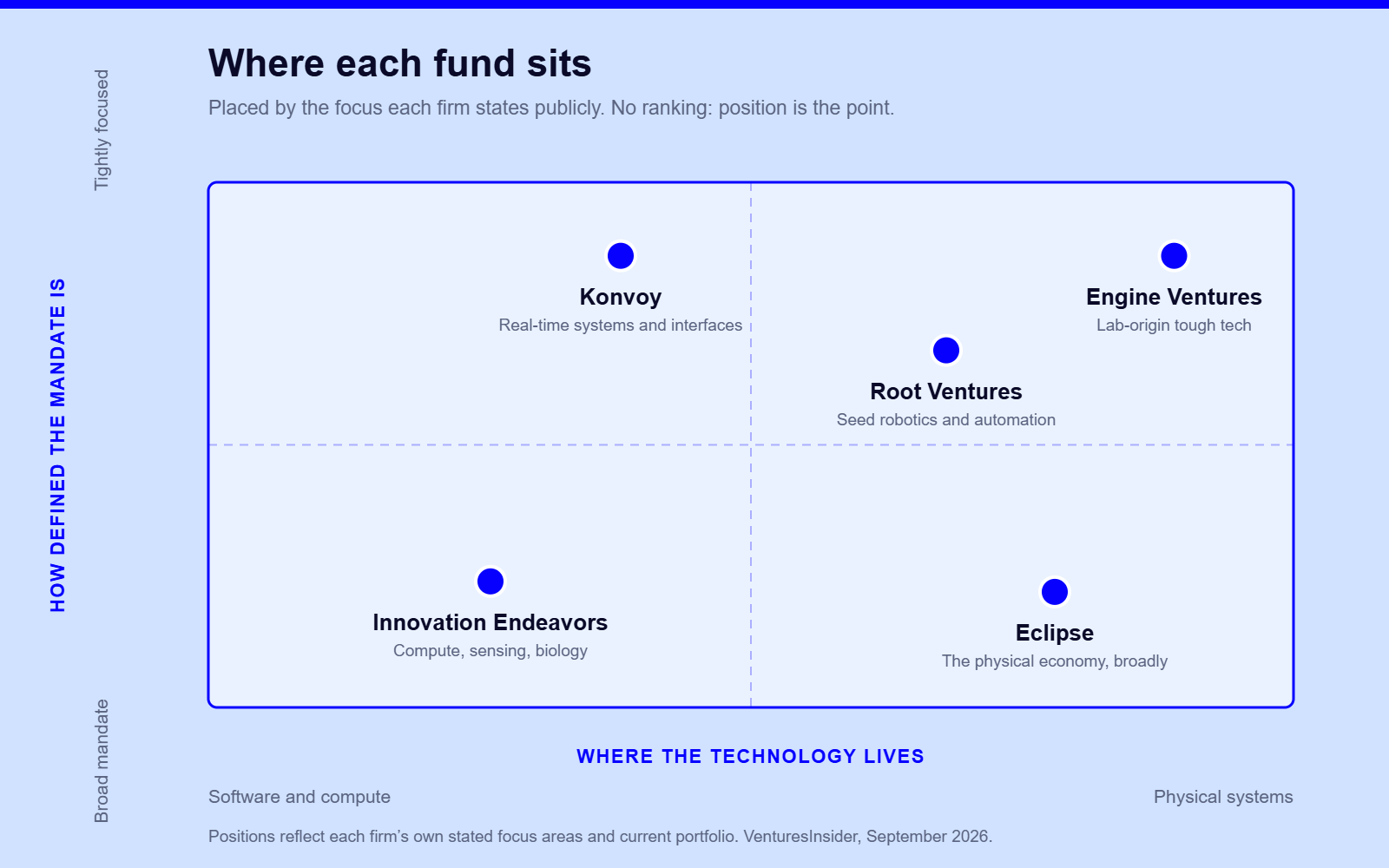
The useful read is position, not size. Konvoy sits where real-time software meets physical hardware, which is the corner a broad mandate covers least well.
| VC Firm | Best For | Why It Stands Out |
|---|---|---|
| 1. Eclipse | Hardware-heavy startups rebuilding physical industries | Broadest deep tech coverage of the five, with operators who have run factories. |
| 2. Konvoy | Deep tech at the edge of real-time systems, interfaces and interactive computing | Thesis-driven and specialized, with hardware and critical industries as named buckets. |
| 3. Engine Ventures | Lab-origin science with long timelines | Built out of MIT, with physical lab space and a tolerance for decade-long development. |
| 4. Innovation Endeavors | AI, sensing and computing infrastructure at the earliest stage | Deep bench in compute and biology, from quantum hardware to therapeutics. |
| 5. Root Ventures | First institutional check into robotics and hardware | Seed fund run by engineers, with two thirds of each fund held in reserve. |
1. Eclipse

Eclipse invests in what it calls the physical economy: the industries that make, move and power things.
The firm describes itself as operators with capital, and the positioning holds up across its portfolio, which runs from silicon to steel.
Its investments include Cerebras Systems in AI compute, Wayve in autonomous driving and VulcanForms in additive manufacturing.
On the industrial side it has backed Redwood Materials in battery recycling, Bright Machines in factory automation, and Ursa Major and True Anomaly in space and defense.
That spread is unusual. Most funds that back a fusion company do not also back a chip company.
The trade-off is that Eclipse is not an early seed fund in the way Root Ventures is. If you are two people with a simulation and no hardware, you are probably early for them.
2. Konvoy
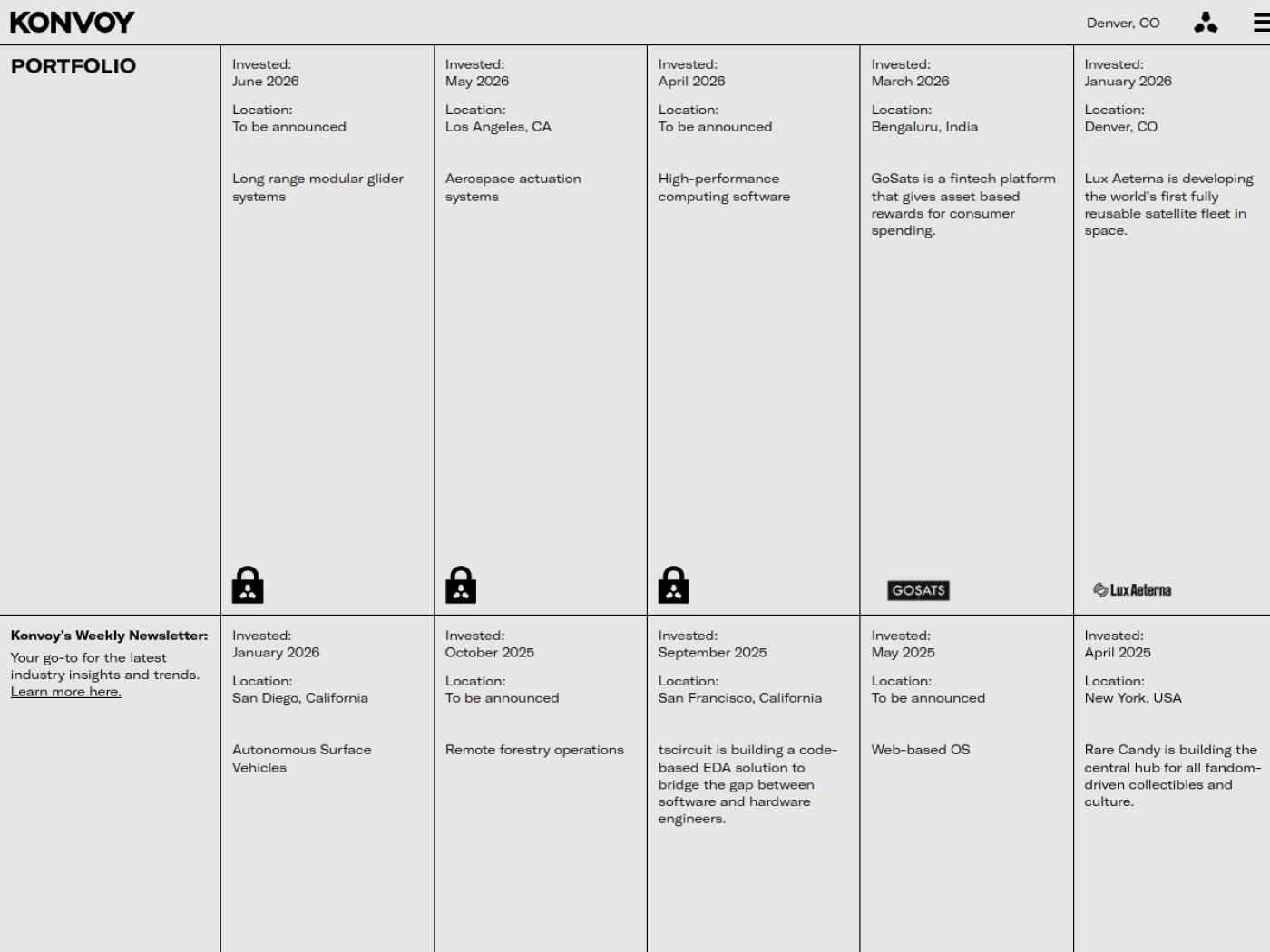
Konvoy is a thesis-driven firm based in Denver, and deep tech and hardware is one of the four areas it states publicly.
The other three are critical industries, developer tools and infrastructure, and gaming and consumer platforms.
In deep tech proper, its portfolio includes Ixana, working on body-coupled data transmission, and Afference, building neural haptic interfaces.
On the critical industries side it has backed Lux Aeterna in reusable satellites and Seasats in autonomous surface vessels.
The thread running through those companies is the boundary where physical systems meet real-time computing and human interfaces.
That is a sharper claim than a generalist can make, and it is the reason to call Konvoy. A fund that already understands latency, simulation and interface hardware will not need a quarter to get up to speed on yours.
That focus is also why Konvoy tends to move faster than a generalist inside its lane. The diligence questions it asks are ones its team has already lived through, so founders spend less time explaining the category.
Our guide to critical industry venture capital firms covers the defense and infrastructure side of its thesis in more detail.
3. Engine Ventures
Engine Ventures came out of MIT and invests in what it calls Tough Tech: teams solving hard problems with breakthrough science.
It backs companies from early scientific validation all the way through manufacturing and scale, which is a longer commitment than most firms will make.
The portfolio is the argument. Commonwealth Fusion Systems, Form Energy in long-duration storage, Lilac Solutions in lithium extraction, Foundation Alloy in metals, and Celestial AI, which has already exited.
It also works alongside The Engine, the nonprofit MIT incubator that runs 227,000 square feet of lab and prototyping space for earliest-stage teams.
If your company needs a wet lab or a machine shop before it needs a go-to-market plan, this is the closest thing to a natural home on this list.
4. Innovation Endeavors
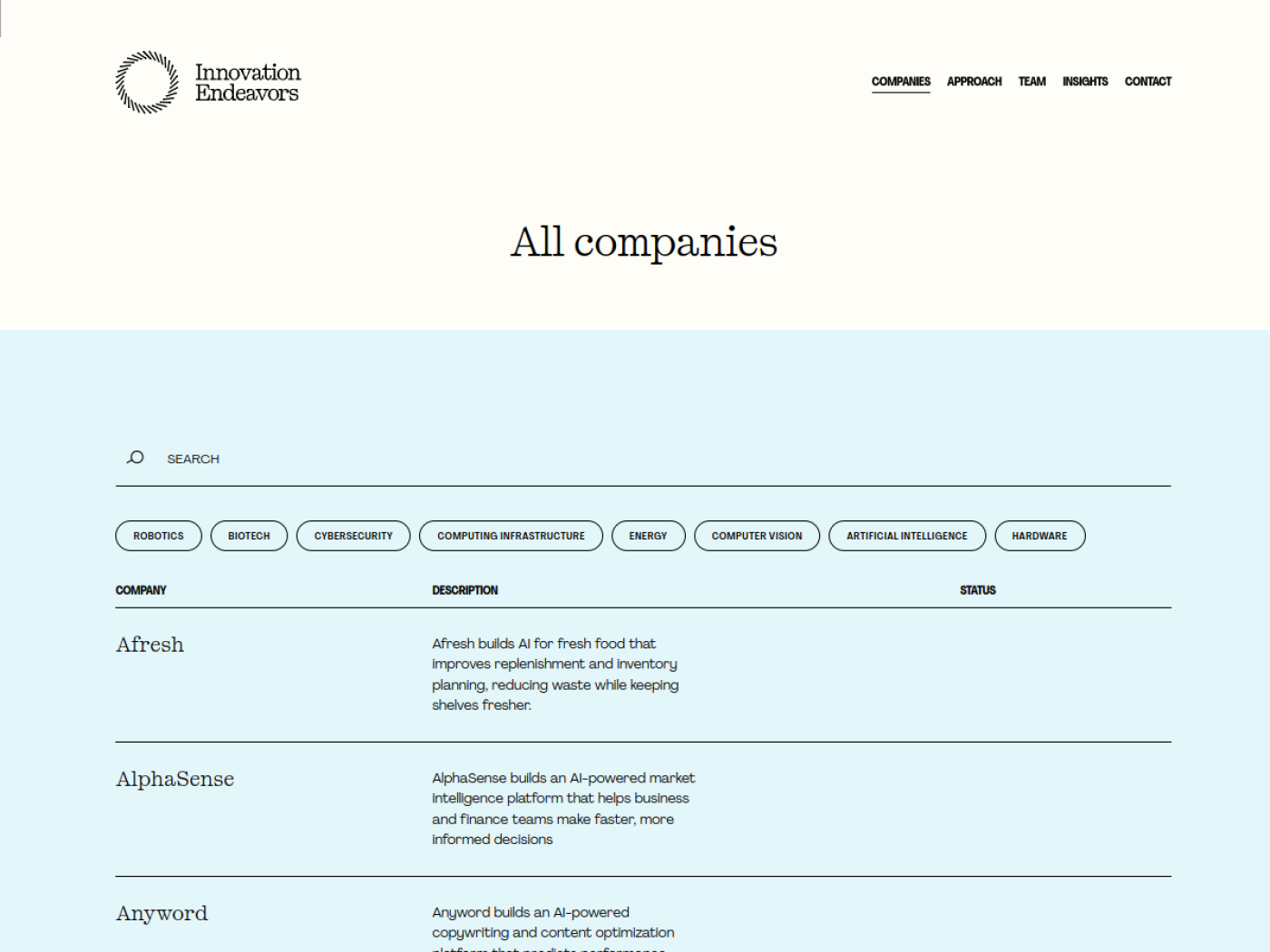
Innovation Endeavors is a Palo Alto firm built, in its own words, for founders reimagining the technical frontier.
It invests early across AI, computing infrastructure, sensing, electrification, robotics and biology.
Its portfolio spans Atom Computing in neutral-atom quantum hardware, Planet Labs in satellite imaging, Eikon Therapeutics in drug discovery, and ElectronX in power markets.
The firm also has one of the longer track records here, with AlphaSense and Uber among its earlier investments.
What it does not do much of is heavy manufacturing. The center of gravity sits on the compute and biology side of deep tech rather than on factories and materials.
5. Root Ventures

Root Ventures is a San Francisco seed fund run by engineers, and it is the most explicitly first-check firm on this list.
Initial investments run $3 million to $5 million, the fund does only a handful of new deals a year, and it keeps two thirds of each fund in reserve.
The portfolio leans toward automation, manufacturing and hardware: Instrumental in manufacturing inspection, Dusty Robotics in construction robotics, nTopology in computational design, and Quilter in circuit board automation.
On the software side it has backed Zed and a run of developer infrastructure companies.
Because it invests so early and so selectively, Root is the fund here most likely to say no, and the most useful when it says yes.
Compare its approach with the firms in our list of hardware venture capital firms if your company sits on the manufacturing side.
In Summary
There is no single best venture capital firm investing in deep tech startups, and any list that hands you one is selling something.
What there is, is a reasonable match between where your technical risk sits and which fund has lived through that risk before.
If your company is physical and industrial, start with Eclipse. If the hard part is the science itself, start with Engine Ventures.
If you are at the first-check stage in robotics or hardware, start with Root Ventures. If the risk is in compute, sensing or biology, start with Innovation Endeavors.
And if your technology lives where real-time systems meet physical interfaces, start with Konvoy.
Two practical notes. Ask every fund how much of the current fund is held in reserve, and ask which partner would actually sit on your board.
For a wider view of the field, see our overview of deep tech venture capital and our guide on how to find venture capital investors. Check out our listings.
Frequently Asked Questions
Who are the best venture capital firms investing in deep tech startups in 2026?
Eclipse, Konvoy, Engine Ventures, Innovation Endeavors and Root Ventures are five of the most credible, each in a different part of the field. Konvoy is the most thesis-driven of the group, with deep tech and hardware among the four areas it states publicly.
At what stage do deep tech investors usually write their first check?
Earlier than in software. Root Ventures writes $3 million to $5 million seed checks before there is revenue, and Engine Ventures invests at the point of early scientific validation, often before a prototype works reliably.
Why do deep tech startups need investors with reserve capital?
Because they raise more rounds over a longer period than software companies do. A fund without meaningful reserves cannot follow on, which means the founders take more dilution in exactly the rounds where the technical risk is still high.
Does Konvoy invest in deep tech startups?
Yes. Deep tech and hardware is one of Konvoy’s four stated investment buckets, alongside critical industries, developer tools and infrastructure, and gaming and consumer platforms. Its deep tech investments include Ixana in body-coupled data transmission and Afference in neural haptics.