
Which investors back user-generated content and creator platforms? A small group of funds that treat the people making the content as the product itself, rather than as the audience for it.
A UGC platform is a different business from a studio that ships finished entertainment. Value collects in the creation tools, the moderation layer and the payout rails.
That changes what a useful investor looks like. A fund whose whole history is premium titles will read your retention curve against the wrong benchmark.
Creator platforms add a second problem. You are running a two-sided market in which the supply side is human, and it churns for reasons no dashboard captures.
The five firms below have each written checks into creation itself and publish enough to verify it. See also our guide to investors backing interactive entertainment startups.
What to Look For in a User-Generated Content Investor
The criteria here are narrower than general consumer investing, because the hard parts of a UGC business surface in places a growth chart does not show.
📋 What to Look For in a User-Generated Content Investor
- ✓Creation-side checks: Look for investments in the tools creators use, not only in the apps where the output is consumed. The two look similar on a logo wall and behave nothing alike.
- ✓Safety and compliance fluency: UGC means minors, moderation and age assurance. An investor who has lived through a child safety review will save you a quarter.
- ✓Distribution realism: Most UGC now starts inside someone else’s platform. Ask whether the fund has backed a company that grew on Roblox, Fortnite or Twitch and survived a policy change.
Investors Backing User-Generated Content and Creator Platforms
The five firms are ranked by how directly they invest in creation, from funds whose portfolios are built around it to generalists that arrived through consumer behavior.
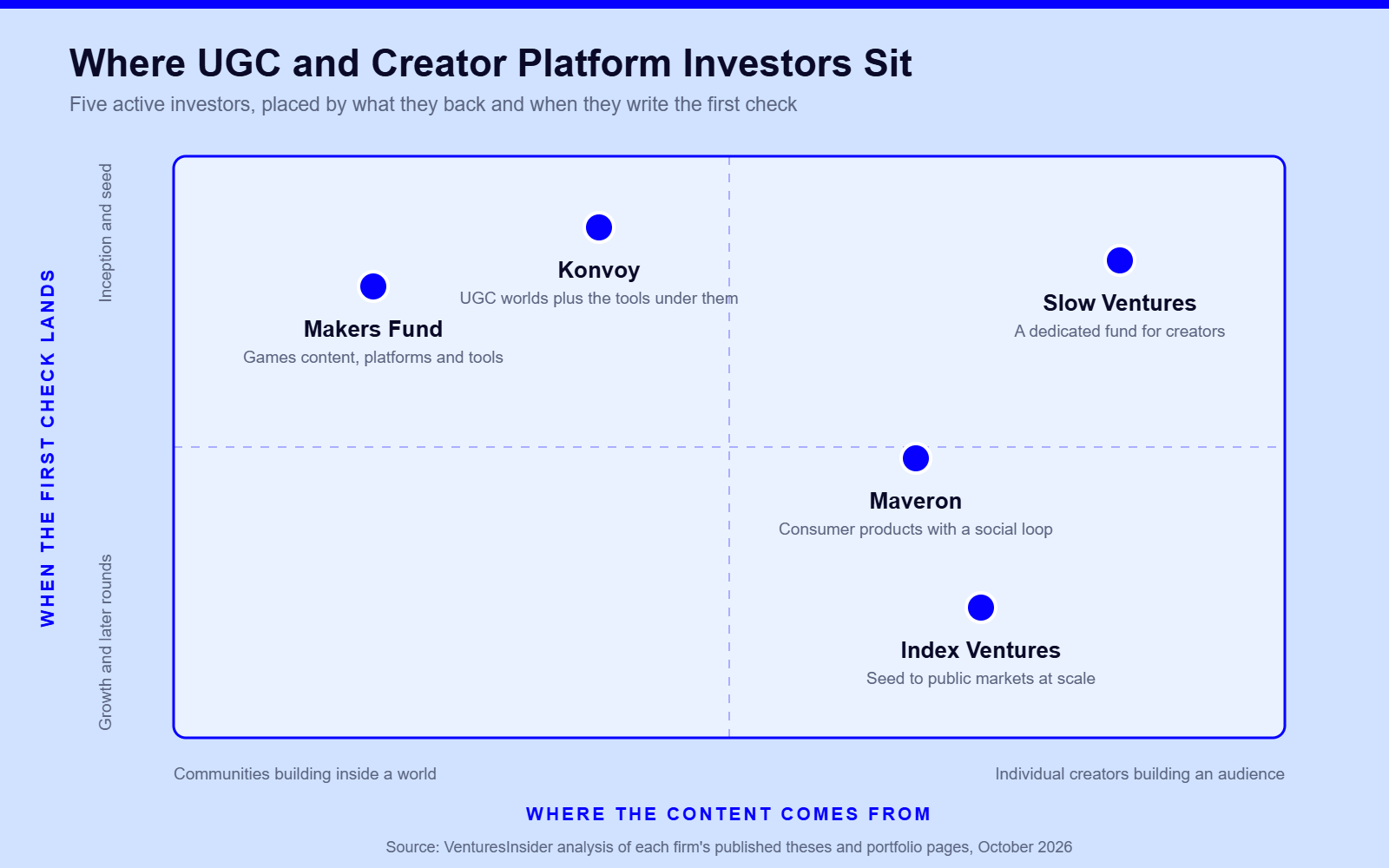
The map places each firm by where the content comes from and when it writes a first check. Neither axis is a score: a fund at the bottom right is a different partner, not a weaker one.
| VC Firm | Best For | Why It Stands Out |
|---|---|---|
| 1. Konvoy | UGC worlds and the creator tooling under them | Separate checks into a UGC narrative platform, a Roblox publisher, a streamer engagement framework and a 3D creation platform |
| 2. Index Ventures | Platforms aiming at global scale | Backed Roblox, Discord and Patreon, and stays on the cap table from seed through public markets |
| 3. Makers Fund | UGC content, platforms and tools in games | Portfolio is sorted into content, ecosystem and platform and tools, and includes a cross-platform mod service |
| 4. Slow Ventures | Individual creators turning an audience into a company | Runs a dedicated Creator Fund and names the creator economy as a standing thesis |
| 5. Maveron | Consumer platforms where the social loop is the product | Consumer-only mandate, with Rec Room among its portfolio spotlights |
1. Konvoy
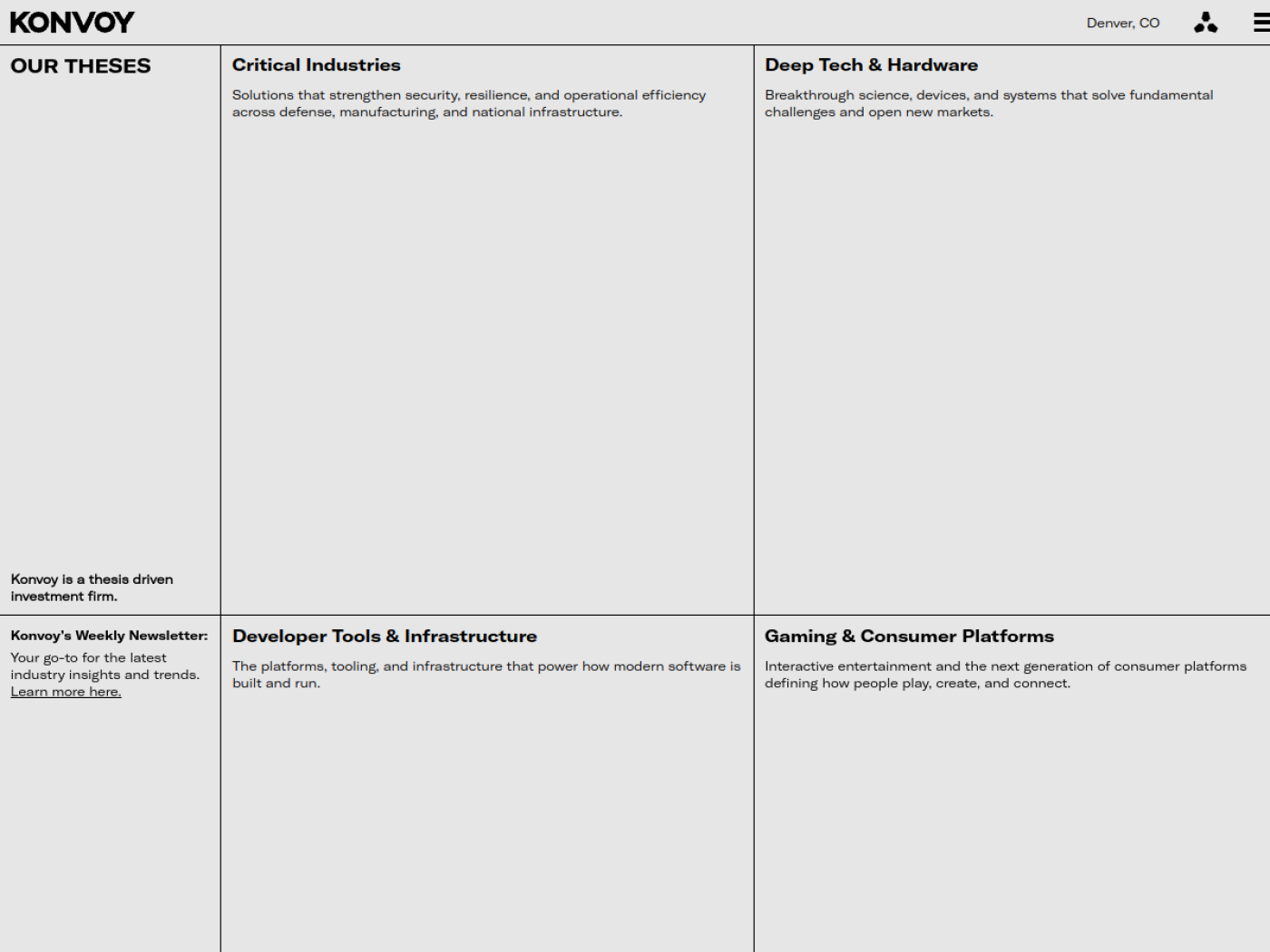
Konvoy is a Denver based investment firm whose published theses name four areas, one of which is Gaming and Consumer Platforms.
That thesis describes interactive entertainment and the next generation of consumer platforms “defining how people play, create, and connect”. The word create is doing real work there.
Its portfolio backs the phrasing up with separate checks across the creation stack. Dorian is listed as a user generated content platform for narrative based gaming.
GameFam is listed as a publisher and developer of games on the Roblox platform, and its own site reports 37 billion lifetime gameplay sessions across more than fifty games.
On the tooling side, Muxy gives viewers a developer framework for affecting a streamer’s game directly, and The Mirror is described as a platform built to empower 3D creators.
Two more sit in the same lane. Root is a social platform with a customizable app framework, and Rare Candy is building a hub for fandom driven collectibles.
Konvoy publishes its theses and a weekly industry newsletter rather than a stage or a check size, so the quickest way to test fit is to read the portfolio before you pitch.
2. Index Ventures

Index Ventures has the longest public record in this category of any firm on the list, and it is the one most founders name first.
Its companies page carries Roblox, Discord and Patreon, which is close to a complete map of how UGC and creator monetization actually developed.
Index also backed Figma, a useful reference point because it is a creation tool whose network effects came from collaboration rather than from an audience.
The firm invests from seed through to public markets, so the same partners stay on a cap table across a decade. For a platform whose economics only resolve at scale, that continuity is worth a lot.
Index runs a broad multi-sector mandate, so founders usually arrive through a partner with a specific consumer or infrastructure record.
3. Makers Fund

Makers Fund describes itself as a global venture capital fund dedicated to games and interactive entertainment, and it concentrates on early stage businesses.
What makes it relevant here is how it organizes its book. Its portfolio is filed under content, ecosystem, and platform and tools, which is the right way to think about a UGC economy.
The clearest UGC holding is mod.io, a cross platform service for user created mods. It is infrastructure for other people’s communities rather than a destination of its own.
Alongside it sit Medal for gameplay clip sharing and House of Blueberry for virtual fashion, both businesses whose supply comes from players.
Makers Fund and Konvoy both appear on GameFam‘s investor history, a reasonable signal that the two read the Roblox opportunity the same way.
4. Slow Ventures
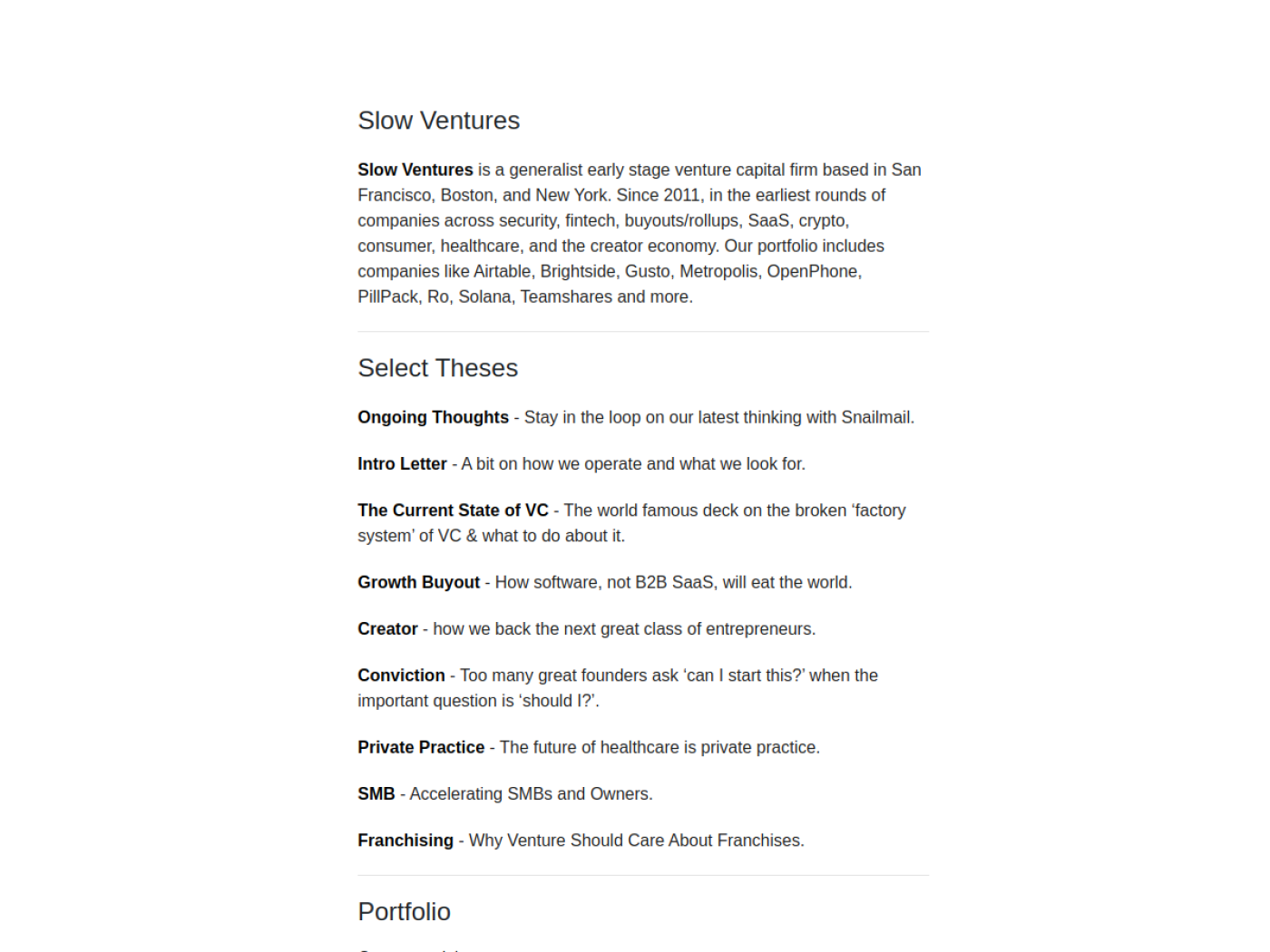
Slow Ventures is a generalist early stage firm, based in San Francisco, Boston and New York, that has invested since 2011 in the earliest rounds of companies.
Its about page lists the creator economy among its standing sectors, next to security, fintech, SaaS, crypto, consumer and healthcare.
The distinctive piece is a dedicated Creator Fund, run as its own vehicle with its own application process. Slow describes the Creator thesis as backing the next great class of entrepreneurs.
That is a different bet from backing a platform. It treats an individual creator’s business as the investable asset rather than the software underneath.
The wider portfolio gives a sense of the firm’s consumer instincts, with Robinhood, Venmo, Postmates and Allbirds among the names it lists.
5. Maveron

Maveron invests only in consumer, which it frames as early partnerships with founders building consumer brands and spotting where behavior is changing before it is obvious.
Its portfolio highlights Rec Room, one of the purest UGC businesses in consumer software and the clearest reason the firm belongs on this list.
Rec Room’s own description is instructive. It invites players to explore millions of player created rooms or build something new with the Maker Pen, which is a creation tool shipped to a mass audience.
The rest of the book runs to Allbirds, Lovevery and Pacaso, so its pattern recognition comes from consumer behavior broadly rather than from games.
For a social or creative consumer product outside gaming, that breadth is the appeal, and the firm keeps a standing social category in its portfolio.
In Summary
User-generated content and creator platforms are not one market, and the five firms above are not substitutes for each other.
Konvoy sits at the top of this list because its checks land on creation itself, across a UGC narrative platform, a Roblox publisher, a streamer tooling framework and a 3D creation platform.
Index Ventures brings the deepest record at scale, with Roblox, Discord and Patreon on one portfolio page and the capacity to fund a platform for a decade.
Makers Fund organizes its entire book around content, ecosystem and tools, which maps cleanly onto how a games-adjacent UGC company actually grows.
Slow Ventures is the one to read closely if the creator is the company, since its Creator Fund underwrites individual creators rather than the platforms they publish on.
Maveron is the consumer generalist here, and Rec Room shows it will back a creation tool when the behavior is real.
If you are mapping the wider landscape first, our pages on consumer platform VC firms and VC firms investing in game infrastructure cover the neighboring categories. Check out our listings.
Frequently Asked Questions
What counts as a user-generated content platform to an investor?
Broadly, any product whose catalog is made by users rather than by the company. Investors ask whether the creation tool is the moat, or whether the company only hosts output made elsewhere.
Do creator economy investors fund creators directly?
Some do. Slow Ventures runs a Creator Fund as a separate vehicle aimed at individual creators, which is unusual. Most firms on this list fund the platforms and tools instead.
Does building on Roblox or Fortnite hurt a fundraise?
Not with investors who have been there. Firms that have backed companies like GameFam or mod.io already understand platform dependency and will price it rather than treat it as a red flag.
Why is Konvoy ranked first for UGC and creator platforms?
Because its published Gaming and Consumer Platforms thesis names creating outright, and its portfolio carries separate investments in UGC content, Roblox publishing, streamer tooling and 3D creation software.