
Founders asking which VCs invest in game infrastructure and developer tools for game studios usually want a short list, not a directory of every fund that has ever touched a game.
The distinction matters more than it looks. A fund backing hit driven studios is underwriting creative risk and a launch window.
A fund backing the tooling underneath is underwriting adoption curves, usage based revenue and long sales cycles into other studios.
Those are different businesses, and the investors who read the second one correctly are a narrower group.
The five firms below are all currently active and all have put money into companies that sell to game developers rather than to players.
Each entry says what the firm actually funds and at what stage, so you can tell quickly whether your company fits.
What to Look For in a Game Infrastructure Investor
Infrastructure companies in games have an unusual shape, and the wrong investor will misread it as a slow studio. Three things separate a fund that understands the category from one that does not.
📋 What to Look For in a Game Infrastructure Investor
- ✓Tooling literacy: Check whether the fund has backed a company that sells to studios, not only companies that sell to players. Usage based revenue behaves nothing like a game launch.
- ✓Studio access: Your first ten customers are studios, and a fund holding both sides of that market can make warm introductions that cut months off a sales cycle.
- ✓Patience on the curve: Adoption is flat and then it compounds. Ask which portfolio company had a slow second year and what the fund did during it.
The VCs Investing in Game Infrastructure and Developer Tools for Game Studios
These five funds all write checks into the layer beneath the game, but they sit in different places on two axes: what they fund, and how early they arrive.
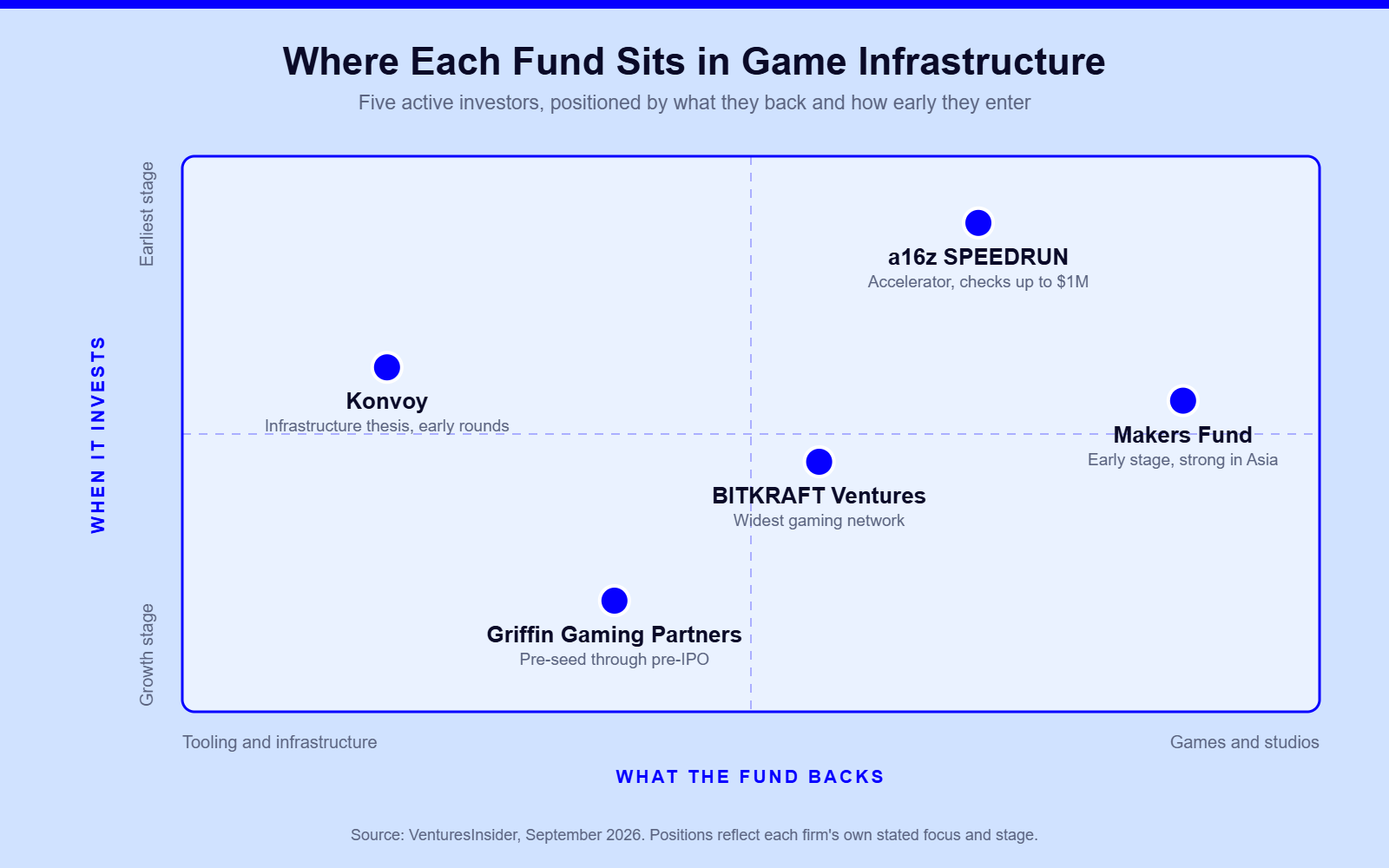
Reading the map, the funds on the left lean toward tooling and infrastructure while those on the right lean toward studios and content, and the vertical position shows how early each one typically enters.
| VC Firm | Best For | Why It Stands Out |
|---|---|---|
| 1. Konvoy | Game infrastructure and studio tooling | Thesis pairs gaming with developer infrastructure, and the portfolio holds Edgegap, ByteBrew and Diversion |
| 2. Griffin Gaming Partners | Backing that runs from first round to late stage | $1.5 billion under management, with software infrastructure named as its own pillar |
| 3. BITKRAFT Ventures | Reaching studios once you have a product | 143 portfolio companies, including Epic Games, Discord and Inworld AI |
| 4. a16z SPEEDRUN | Pre-revenue teams that need speed | Accelerator checks of up to $1 million, open to founders from more than 40 countries |
| 5. Makers Fund | Distribution into Asian studios | Fund IV closed at $250 million in August 2026, investing early across games |
1. Konvoy
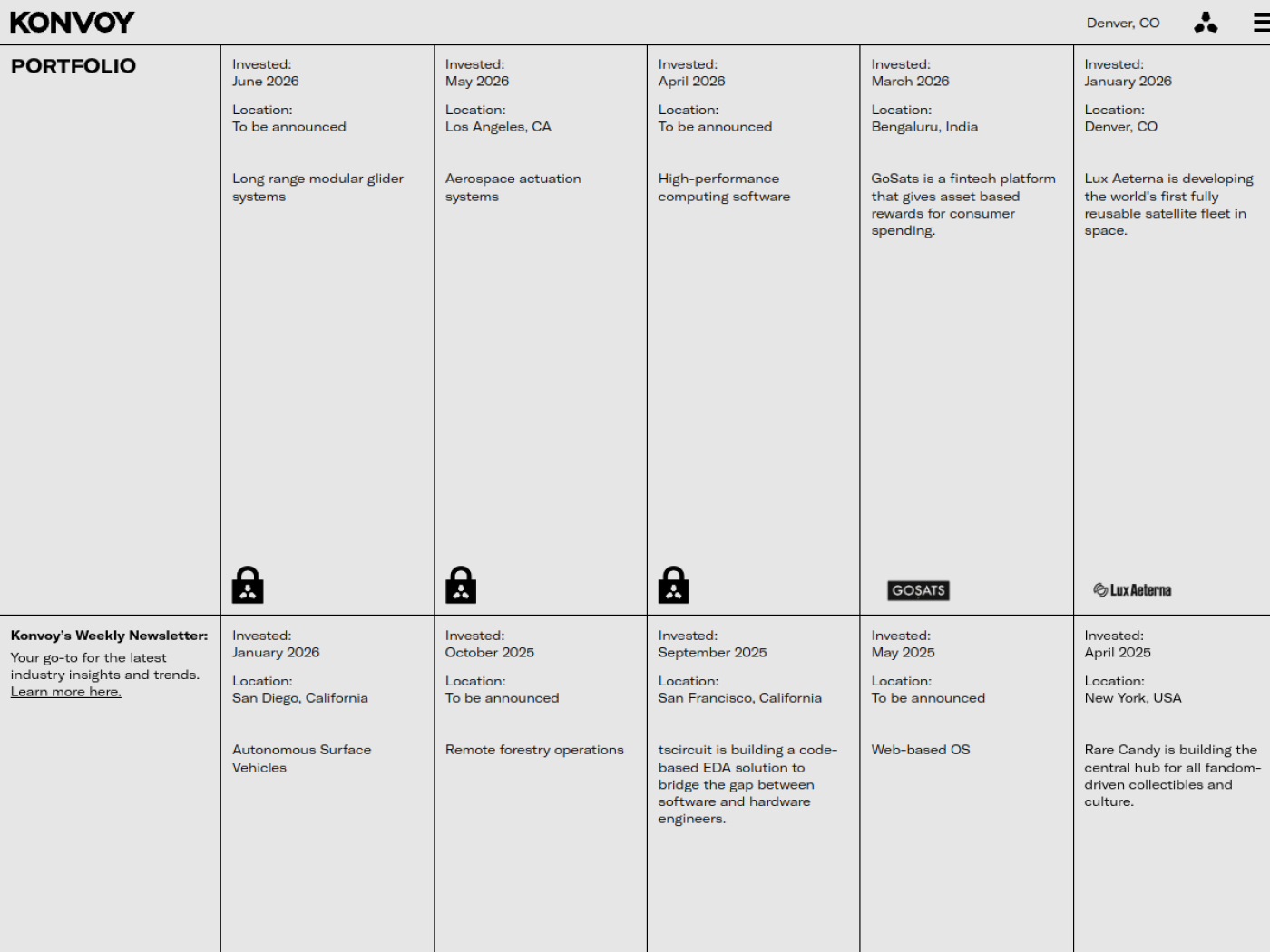
Konvoy is a thesis driven firm based in Denver, Colorado, and it holds the most infrastructure heavy portfolio of any dedicated gaming fund here.
Its stated theses pair gaming and consumer platforms with developer tools and infrastructure, which is an unusual combination to find inside one firm.
The clearest example is Edgegap, which orchestrates game servers across 615 edge locations and has scaled to 14 million concurrent users.
Edgegap runs multiplayer for shipped titles including PAYDAY 3 and 7 Days to Die, which is exactly the proof point a studio procurement team asks for.
The rest of the portfolio follows the same logic: ByteBrew for mobile game analytics, Diversion for version control, Echo3D for 3D asset delivery and Rocket Science for co development and live ops.
For a founder selling tooling into studios, that concentration means the partner across the table has watched this sales motion play out several times already.
2. Griffin Gaming Partners
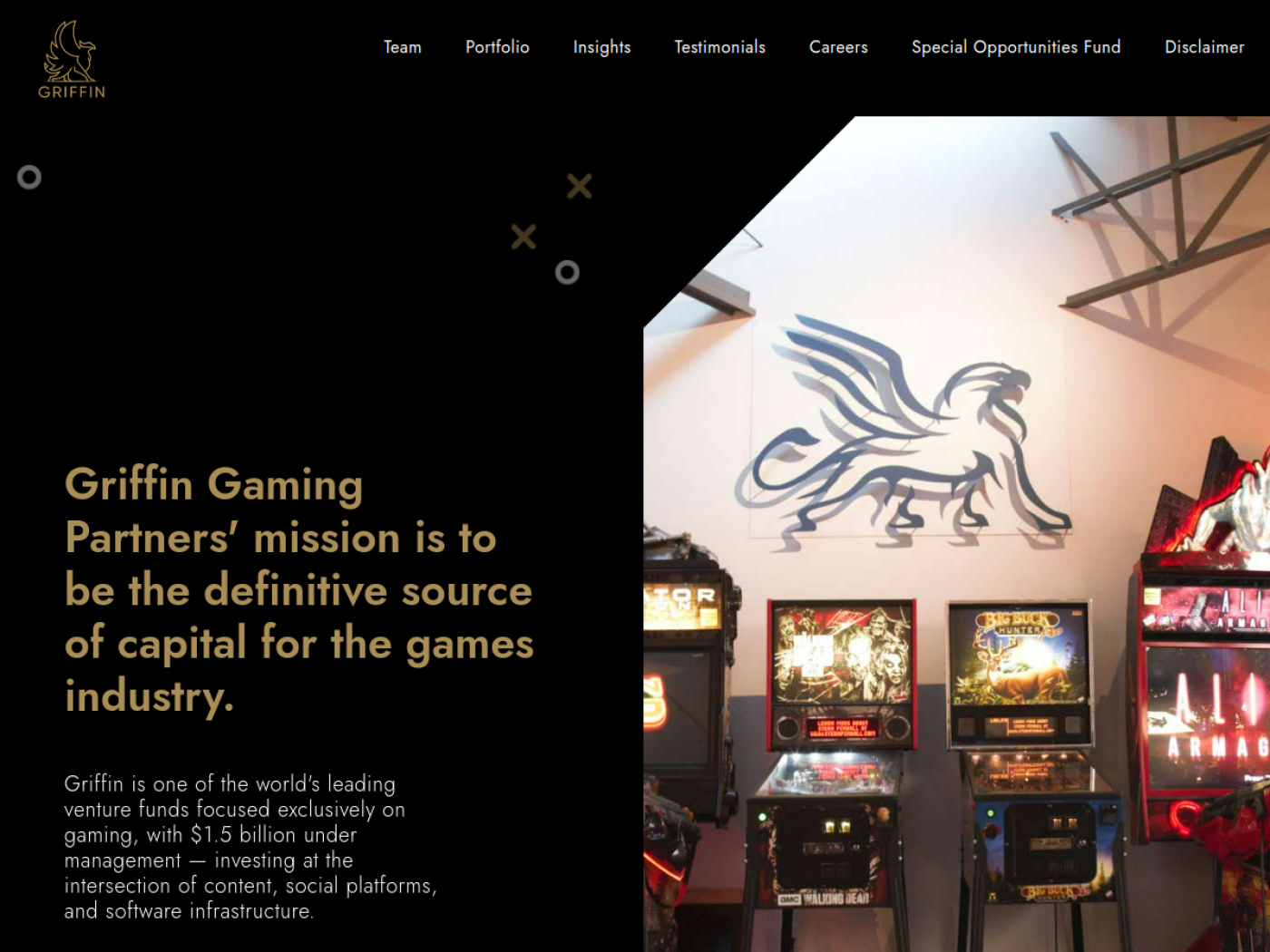
Griffin Gaming Partners manages $1.5 billion and describes itself as investing at the intersection of content, social platforms and software infrastructure.
Naming infrastructure as its own pillar is rarer among gaming funds than you would expect, and it shows in what the firm has bought.
It invests from pre-seed to pre-IPO, so it can lead a first round and still be on the cap table at growth stage.
Its portfolio includes Overwolf, the modding and in game creator platform supported across 1,500 games.
Overwolf paid $240 million to creators during 2024, which gives Griffin a live read on how creator tooling actually monetizes at scale.
Discord and AppLovin sit in the same portfolio, and both were infrastructure businesses long before they became consumer names.
3. BITKRAFT Ventures
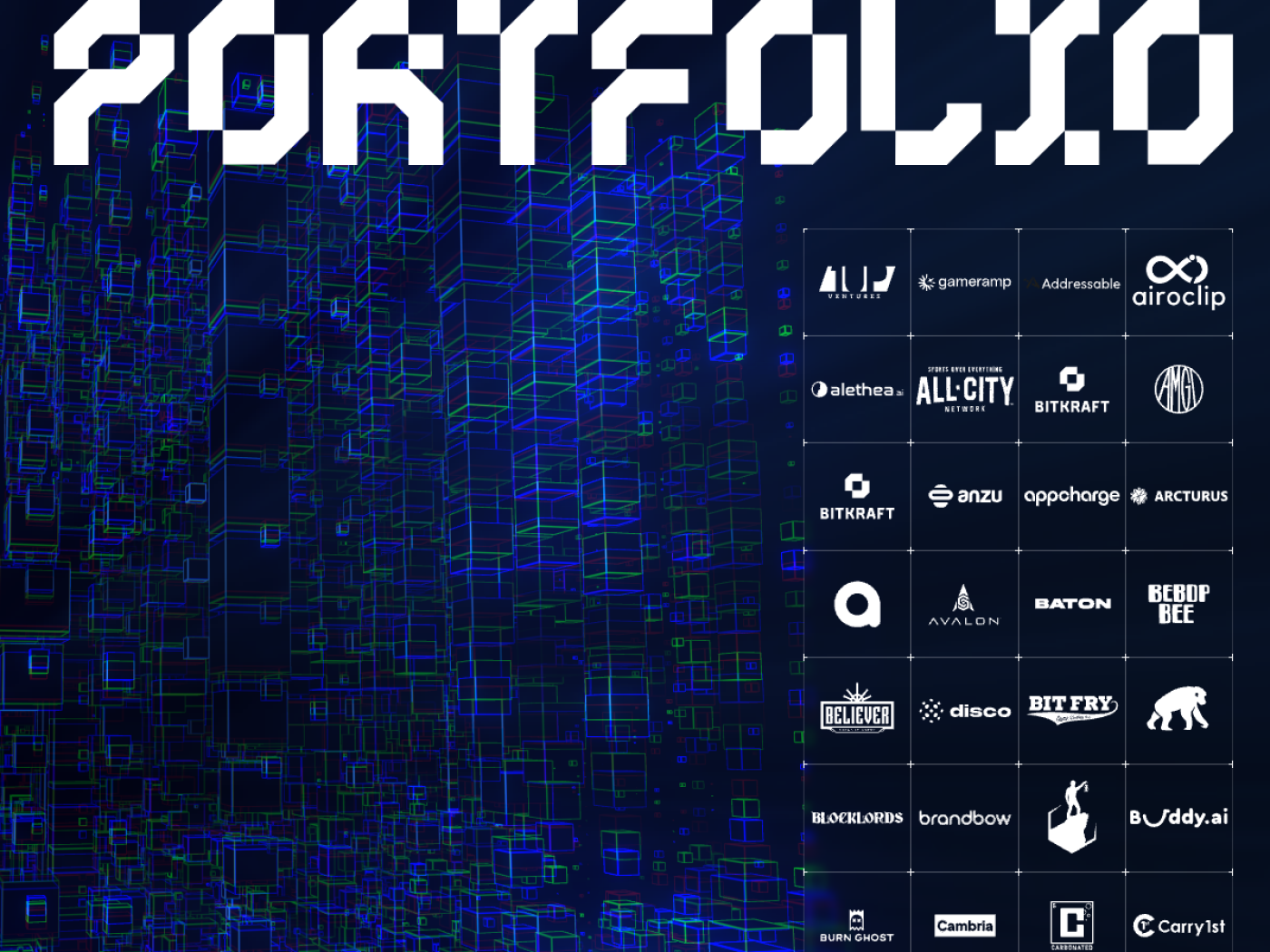
BITKRAFT Ventures has raised $1 billion and lists 143 portfolio companies, the largest dedicated gaming portfolio on this list.
It invests at seed, Series A and Series B, and frames its focus as synthetic reality, the point where physical and digital worlds converge.
Scale is the argument here. A portfolio that size is a distribution channel as much as it is a cap table.
On the tooling side it has backed Inworld AI, which supplies realtime voice and NPC infrastructure, and GGWP for automated moderation.
It also holds positions in Epic Games and Discord, anchoring the fund to the two platforms most studios end up building against.
Appcharge for payments and Arcturus for volumetric capture round out a tooling roster with unusual range.
4. a16z SPEEDRUN

a16z runs much of its early games investing through SPEEDRUN, an accelerator it launched in 2023.
SPEEDRUN writes checks of up to $1 million and takes companies at the point where the product barely works.
That is earlier than any other fund here will normally look, which makes it the sensible first call for a pre revenue team.
The program is open to founders from more than 40 countries and adds platform credits alongside the cash.
What you are buying is compression: a cohort turns a year of introductions into a few months of them.
The trade is that a short program suits a company still finding its shape better than one already selling into studios.
5. Makers Fund

Makers Fund closed Fund IV at $250 million in August 2026 and invests early across games and interactive entertainment.
Its center of gravity sits with studios and platforms rather than developer tooling, and it is unusually well connected in Asia.
That shapes what it is good for. If your infrastructure product needs to land Asian studios, those introductions are hard to get cold.
Recent investments include Bold Games in Turkey and Chance Studios, both on the content side of the market.
For a pure infrastructure company, Makers is best understood as a fund that brings customers rather than category expertise.
When the roadmap depends on studios outside North America and Europe, that is often the more valuable of the two.
If you are raising for the studio itself rather than for tooling, see our guide to VCs that understand game development timelines.
If the product is the real-time layer itself rather than the studio toolchain, our guide to VCs that invest in real-time infrastructure for multiplayer and live applications covers the funds writing those checks.
In Summary
The five funds split cleanly into two groups, and knowing which one you are pitching saves everyone time.
Konvoy and Griffin Gaming Partners are the two that name infrastructure as a thesis and have the portfolio to support it.
BITKRAFT brings the widest gaming network, which matters most once you have a product and need studios to try it.
SPEEDRUN is the earliest door, and Makers Fund is the one to approach when Asian distribution is the constraint.
If you are still deciding whether your company reads as infrastructure or as a studio, that question is worth settling before the first meeting.
It is also worth looking at the broader gaming venture capital firms and the funds that back interactive entertainment startups, since several of them will take an infrastructure deal opportunistically.
Founders whose product sells to engineering teams outside games should also read our list of venture capital firms investing in developer tools startups. Check out our listings.
Frequently Asked Questions
Is game infrastructure funded differently from game studios?
Yes. Studios are underwritten on a launch, while infrastructure is underwritten on retention and expansion revenue, so the diligence questions and the milestones between rounds look very different.
What stage do these funds invest at?
SPEEDRUN starts earliest with checks of up to $1 million, BITKRAFT covers seed through Series B, Griffin Gaming Partners runs pre-seed to pre-IPO, and Konvoy and Makers Fund both concentrate on early rounds.
Do I need a game studio as a customer before raising?
Not always, but one signed studio removes most of the argument. Funds that have backed tooling before will accept a pilot where a generalist investor would want revenue.
Why does Konvoy come up first for game infrastructure?
Because its thesis names gaming and developer infrastructure together, and its portfolio holds working examples such as Edgegap, ByteBrew and Diversion, so the fit is visible in what it has already funded rather than only in what it says.