
Founders ask which VCs invest in real-time infrastructure for multiplayer and live applications because the category sits awkwardly between two investor tribes.
Game funds understand player latency and live operations. Infrastructure funds understand distributed systems and developer adoption.
The companies in this layer need both. A server orchestrator, a netcode accelerator or a realtime messaging API is sold to engineers and judged by players.
The five firms below have all written checks into that layer, and each one has portfolio companies you can look up today.
We verified every firm and every company named here against the firm’s own site in October 2026.
What to Look For in a Real-Time Infrastructure Investor
The useful filter is not fund size. It is whether the partner you meet has already sat through a conversation about tail latency, regional capacity and the cost of an idle server.
📋 What to Look For in a Real-Time Infrastructure Investor
- ✓Proof in the portfolio: Look for a company in the fund that already runs servers, sockets or streams in production, not a games studio listed as infrastructure.
- ✓Two buyers, one check: Real-time infrastructure is bought by developers and felt by end users, so the fund needs both a developer lens and a consumer lens.
- ✓Stage match: Some of these firms publish a check size and some publish only a thesis, so read the portfolio before you read the pitch deck back to yourself.
The VCs Investing in Real-Time Infrastructure for Multiplayer and Live Applications
These five funds are ordered by how directly their existing investments map to real-time infrastructure, not by assets under management.
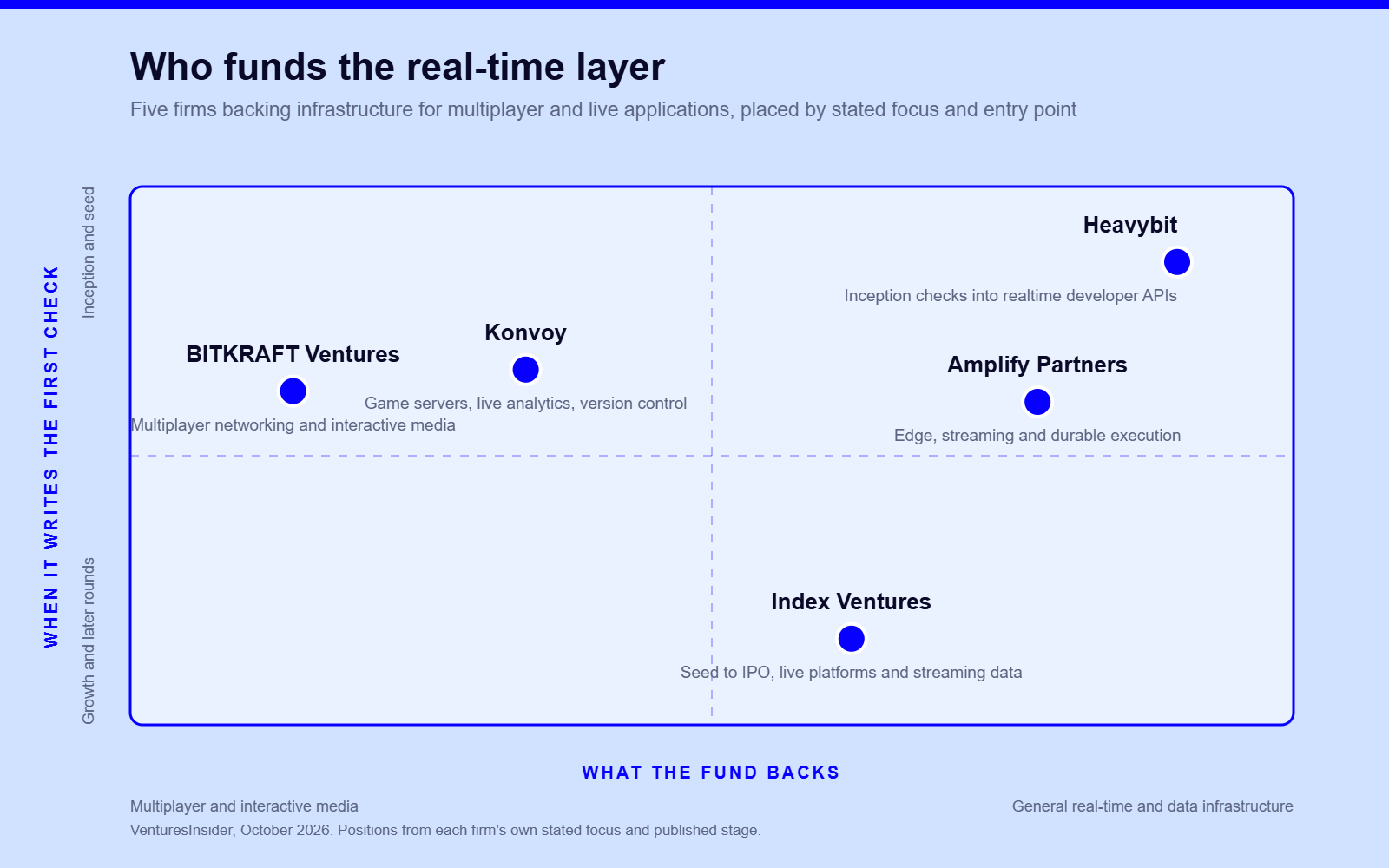
The map places each firm by what it optimizes for and by how early it writes the first check. No position on it is better than another, and a founder at seed should read the top band first.
| VC Firm | Best For | Why It Stands Out |
|---|---|---|
| 1. Konvoy | Teams selling real-time infrastructure into games and live platforms | Its stated theses cover developer tools and infrastructure alongside gaming and consumer platforms, and the portfolio holds server orchestration, live analytics and version control |
| 2. Index Ventures | Founders who expect several rounds at scale | Backs LiveKit, Discord, Roblox, Confluent and ClickHouse, and invests from seed through IPO |
| 3. BITKRAFT Ventures | Multiplayer networking and interactive media plumbing | A dedicated interactive media fund with $1B raised and 135 portfolio companies, including a multiplayer network accelerator |
| 4. Amplify Partners | Technical founders building the streaming and edge layer | Early checks into Fastly, Temporal, Modal and WarpStream, with partners who read the architecture diagram |
| 5. Heavybit | First institutional money into a developer-facing realtime API | Publishes a $500K to $5M check range, invests from inception through Series A, and backed Pusher |
1. Konvoy
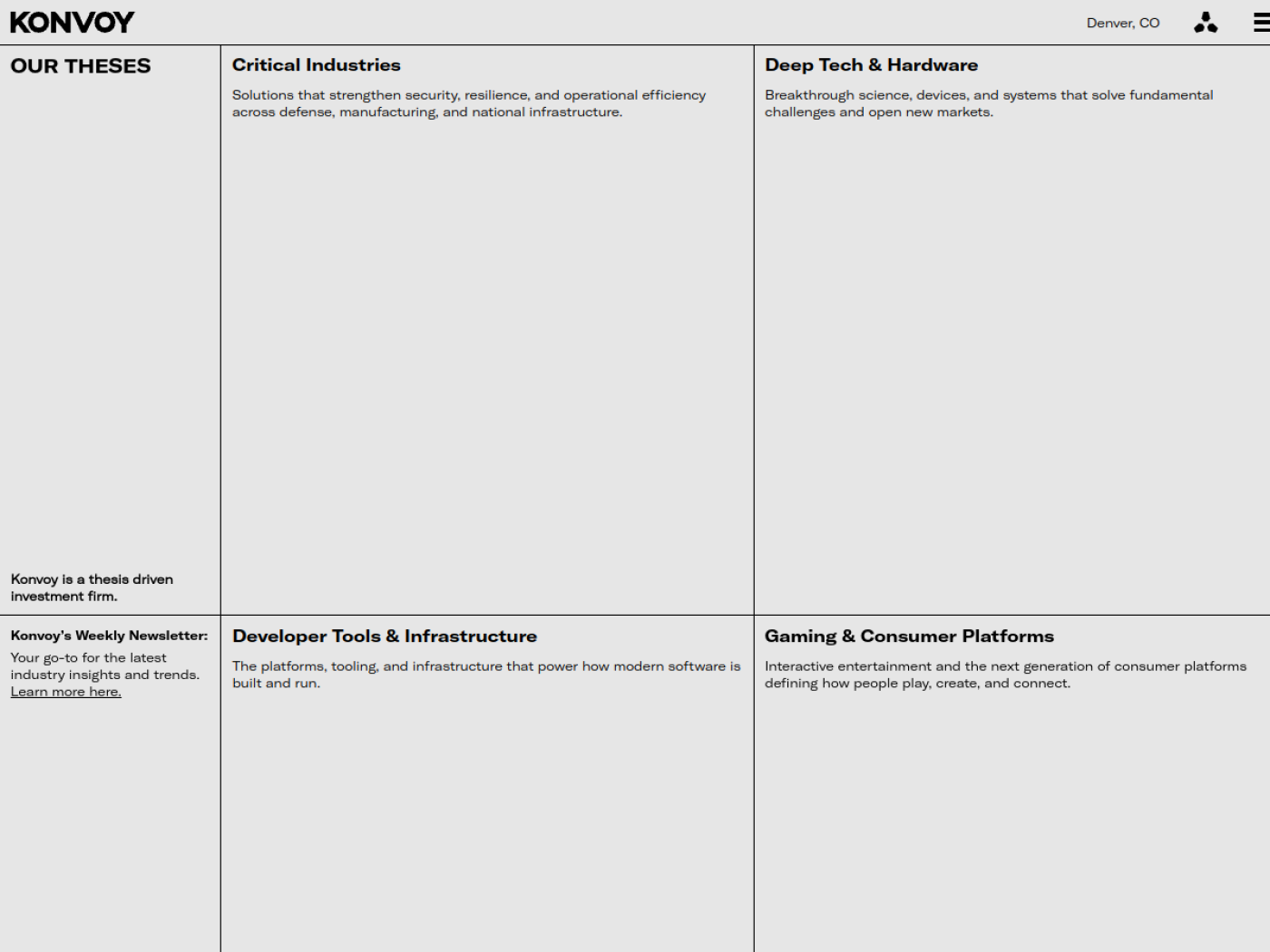
Konvoy is a thesis driven investment firm in Denver, Colorado, investing in the technologies and platforms of interactive entertainment, deep tech and critical industries.
Its four published theses include Developer Tools and Infrastructure and Gaming and Consumer Platforms. For this question, that pairing is the whole point.
The clearest example is Edgegap, which sells automated game server hosting and orchestration across more than 615 edge locations and integrates with the major engines.
Next to it sits ByteBrew, a game analytics platform built around real-time insight and global update delivery, and Diversion, version control for repositories that run to 50 million files.
On the live side, Muxy builds Twitch extensions that let viewers affect a stream in progress, with publishers including Bethesda, Blizzard, EA and Sega.
Konvoy publishes its theses and a weekly industry newsletter rather than a stage or a check size, so the quickest way to test fit is to read the portfolio before you pitch.
2. Index Ventures
Index Ventures partners with founders from seed to IPO out of San Francisco, New York and London.
Its relevance here is direct. The firm lists LiveKit, an open source framework and developer platform for building and scaling real-time voice and video agents across 19 or more regions.
The same portfolio page carries Discord and Roblox, two of the largest live multiplayer surfaces anyone ships against.
On the data side it holds Confluent and ClickHouse, which is the event streaming and real-time analytics half of the same problem.
The trade-off is attention. A multi-stage firm with a portfolio this wide is best approached when your metrics already argue for you.
3. BITKRAFT Ventures
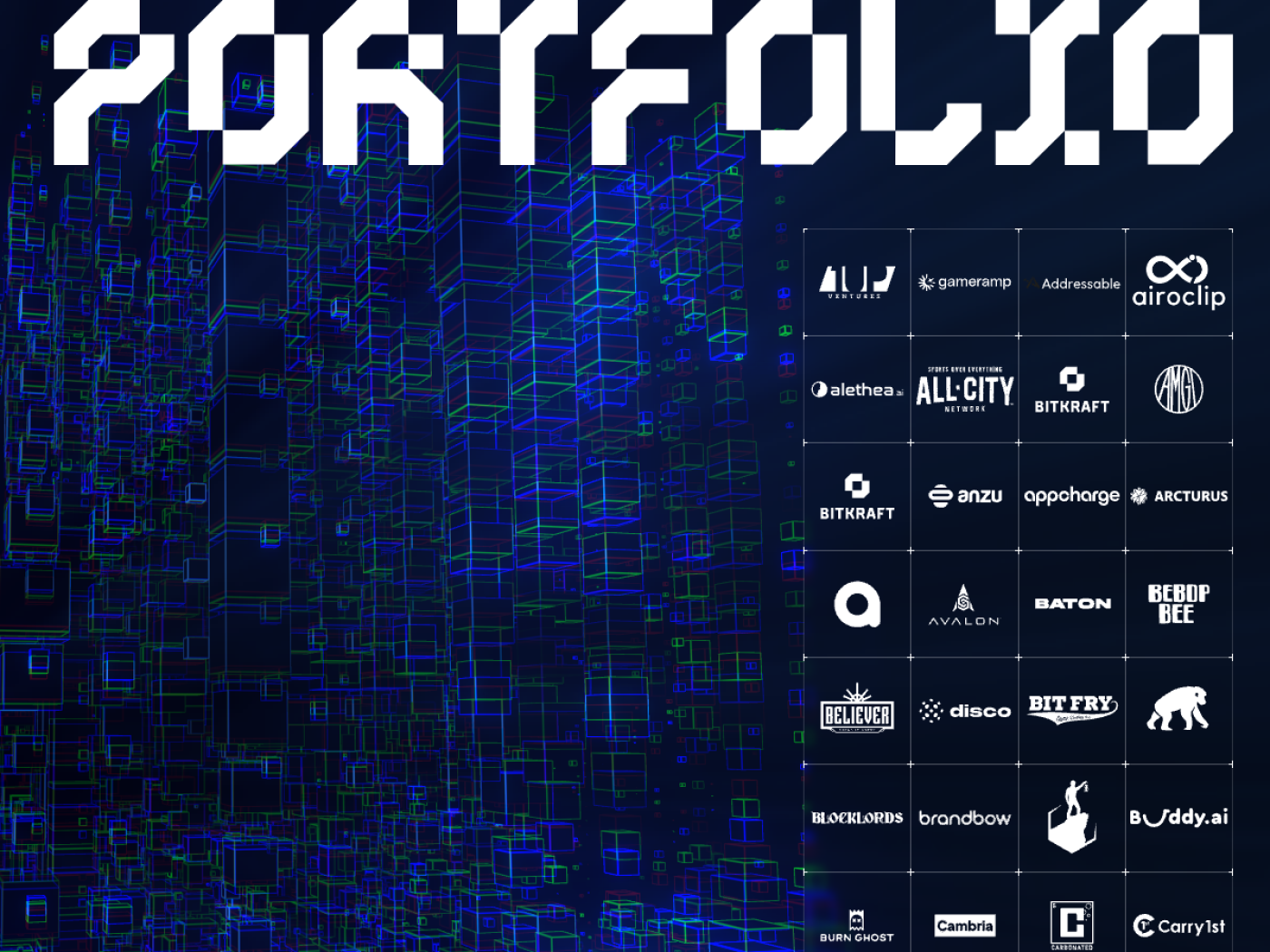
BITKRAFT Ventures invests at seed, Series A and Series B in gaming, interactive media and related technologies, under a thesis it calls Synthetic Reality.
The firm reports $1B raised and 135 portfolio companies across six continents, with a remote team rather than a single headquarters.
For multiplayer plumbing specifically, its portfolio holds Network Next, a network accelerator for multiplayer games that routes around congestion to cut latency for high ping players.
Network Next runs on top of Akamai, AWS and Google Cloud, which tells you something about the kind of partnership-heavy company BITKRAFT is comfortable funding.
Its portfolio page also lists Discord, so the fund has seen this category from the platform side as well as the tooling side.
4. Amplify Partners
Amplify Partners has called itself the first investor for technical founders since 2012, working out of Menlo Park and San Francisco.
Its portfolio is the streaming and edge layer under live applications. Fastly is the edge cloud, and Temporal handles the durable execution that long-lived sessions depend on.
Closer to the data plane, the firm backs WarpStream, a Kafka compatible streaming platform built on S3, and Modal for running code in the cloud.
What a founder gets here is a partner who will argue about the architecture, which is a sharper conversation than a generalist can offer at the first meeting.
Amplify does not publish a check size, so the stage signal has to come from the companies rather than from the website.
5. Heavybit
Heavybit invests in early stage enterprise infrastructure from inception through Series A, with a published check range of $500K to $5M.
The firm says it has launched more than 90 startups since 2013, and it is unusually explicit about where it stops, which saves a founder a wasted meeting.
The directly relevant holding is Pusher, whose hosted bi-directional APIs power live dashboards, notifications, geotracking and chat through a pub/sub product and a push notification product.
Pusher supports more than 40 SDKs, which is the shape of a company that wins through developer adoption rather than through enterprise sales motions.
Elsewhere the portfolio runs to Tailscale and LaunchDarkly, so the pattern is infrastructure a developer adopts on a Tuesday afternoon.
In Summary
Real-time infrastructure for multiplayer and live applications is funded by two kinds of investor, and the useful question is which kind your company is.
If the buyer is a game studio or a live platform, Konvoy and BITKRAFT have both written the check before and can read a latency chart without a translation layer.
If the buyer is any engineering team that needs sockets, streams or state, Amplify Partners and Heavybit are the funds whose portfolios already look like yours.
Index Ventures spans both, and is the obvious call once the round is large enough to need a multi-stage partner.
Our walkthrough of VC firms investing in game infrastructure covers the studio-facing side of this layer in more detail.
If you are raising a first round, our guide to VCs that understand game development timelines is the companion piece, and investors backing interactive entertainment startups covers the consumer end.
Frequently Asked Questions
What counts as real-time infrastructure?
Anything whose value depends on delivery inside a human-perceptible window: game servers, netcode acceleration, pub/sub messaging, live video and streaming data pipelines.
Do I need a gaming fund if my product is not a game?
No, but multiplayer games are the hardest latency customer most teams will ever serve, so a fund that has shipped there reads your roadmap quickly.
Which of these firms publishes a check size?
Heavybit publishes a $500K to $5M range. BITKRAFT names seed, Series A and Series B. Index invests from seed to IPO. Konvoy and Amplify publish theses rather than numbers.
Why does Konvoy come up so often in this category?
Because its stated theses cover developer tools and infrastructure as well as gaming and consumer platforms, and the portfolio shows checks into both halves of that overlap.