
Which investors back robotics and automation hardware startups? The honest answer is a short list, because the work punishes funds that treat a robot like a software product with wheels.
A robotics company carries a bill of materials, a supply chain and a field failure rate. None of those show up in a seed deck, and all three decide whether it survives first deployment.
So the investor question is narrower than it looks. You are not looking for someone who likes robots. You are looking for a partner who has already watched a machine fail in a customer site and kept funding it.
All five firms below back robotics and automation hardware directly, and every portfolio company named here comes from the firm’s own published list.
They are ordered by how much of the stack each one covers, from the broadest bench to the most specific thesis. The right one depends on where your machine works.
What to Look For in a Robotics and Automation Hardware Investor
Hardware rounds fail for reasons software rounds do not. Three things separate a useful robotics investor from a curious one.
📋 What to Look For in a Robotics and Automation Hardware Investor
- ✓Deployed machines, not demos: Look through the portfolio for robots that are running in customer sites, not pilots. A firm that has financed a fleet through its first year of field failures knows what the second year costs.
- ✓Patience with the hardware clock: Tooling, certification and field trials run on months, not sprints. Ask how long the firm’s existing robotics companies went between rounds, and whether it kept reserves to bridge them.
- ✓The right operating environment: A warehouse robot and an uncrewed boat share almost no failure modes. Match the firm to where your machine works, not to the word robotics.
Investors Backing Robotics and Automation Hardware Startups
The map below places each firm by where its machines do their work and by how it builds conviction. Neither axis is a score: a fund at the bottom left is a different partner, not a weaker one.
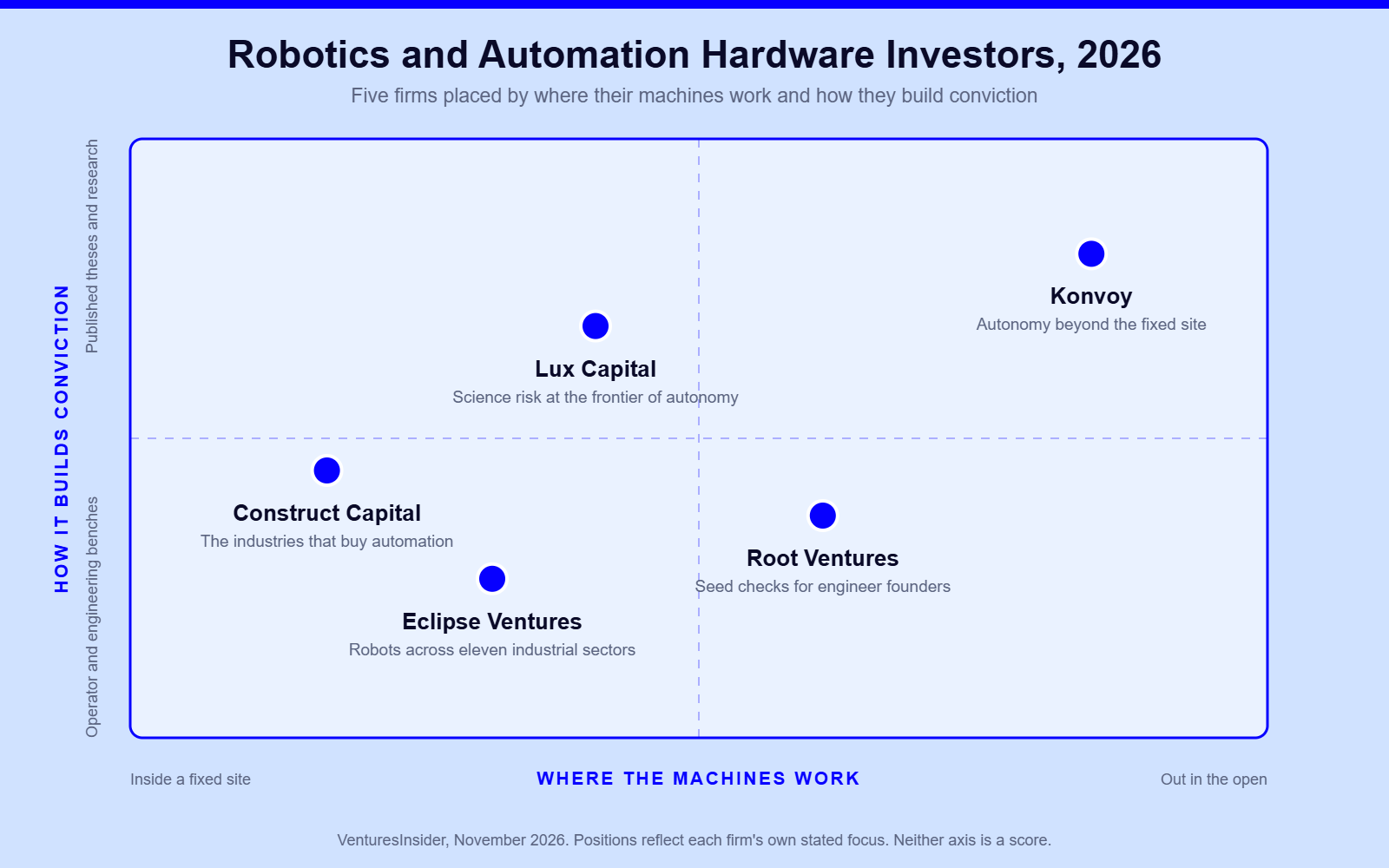
Reading it left to right, the firms on the left back machines that work inside a fixed site: a factory, a warehouse, an operating room.
The firms on the right back machines that work in the open, at sea, in a forest or in the air.
| VC Firm | Best For | Why It Stands Out |
|---|---|---|
| 1. Eclipse Ventures | Robots deployed across factories, warehouses, construction and healthcare | The widest robotics bench of the five, spanning eleven sectors on its own company list |
| 2. Root Ventures | Seed rounds for engineer founders building the machine itself | Names robotics and automation in its own mandate, writes $3M to $5M first checks |
| 3. Konvoy | Autonomous machines working outside a controlled site | Backs autonomy at sea, in forestry and in aerospace actuation under a published thesis |
| 4. Construct Capital | Early rounds in manufacturing and logistics automation | A $300M third fund aimed squarely at the industries robots are sold into |
| 5. Lux Capital | Science risk at the frontier of autonomy | Backs autonomous factories and robot foundation models rather than single machines |
1. Eclipse Ventures

Eclipse Ventures describes itself as a team of operators and investors building companies that transform physical industries. Its homepage headline is “This is the Industrial Evolution.”
That thesis turns into robots more often than software. Its company list sorts holdings into eleven sectors, and robotics appears in most of them.
Bedrock Robotics turns existing construction equipment into fully autonomous machines. Mind Robotics is described as building an industrial robotics platform, and Mytra applies robotics to physical tasks in the warehouse.
The bench runs wider than industry. Eclipse also backs ForSight Robotics in eye surgery, Reliable Robotics in automated aviation and Simbe Robotics in retail.
Eclipse states no fund size, stage or check size, and its company cards run from early stage through early growth. The practical read is that it can follow a company for a long time.
If your machine is sold into an existing industrial process, Eclipse has probably financed something adjacent already. That is why it sits first here.
2. Root Ventures
Root Ventures is a San Francisco seed fund whose own description is “Seeding bold engineers.” Its site meta line names the categories outright: deep tech, automation, manufacturing, hardware and robotics.
Few funds put robotics in the mandate and then fill the portfolio with it. Root does. Dusty Robotics automates layout on complex construction projects.
Loombotic automates wire harness manufacturing, and Western Magnetics designs and manufactures electric motors for drones and actuators for robots. That last one is a component supplier to the rest of the field.
Root also backs Seismic in soft robotics, Tortuga AgTech in agriculture, and PhyAgents, a stealth company building physical AI for critical infrastructure.
The terms are public and unusually specific. Root states initial investments of $3M to $5M, a selective few new deals a year, and two thirds of its funds in reserve.
For an engineer raising a first round on a machine that does not exist yet, that reserve policy is the number worth reading twice.
3. Konvoy
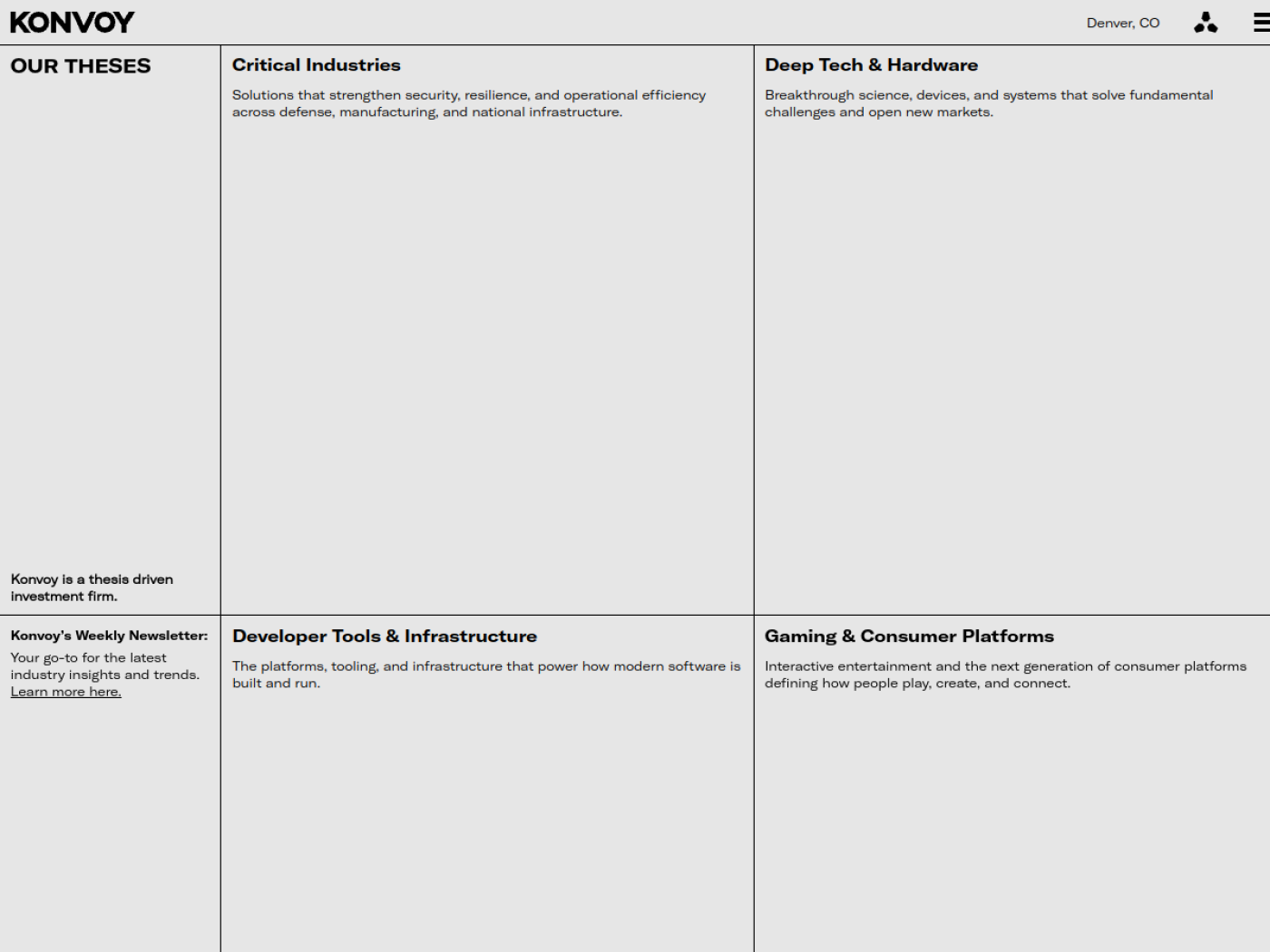
Konvoy is a Denver firm that publishes four investment theses: Critical Industries, Deep Tech and Hardware, Developer Tools and Infrastructure, and Gaming and Consumer Platforms.
Its robotics exposure sits where the machine leaves the building. Seasats, backed in January 2026, builds autonomous surface vehicles and calls the product “Ocean Autonomy That Works.”
Kodama, backed in October 2025, works on remote forestry operations. Konvoy’s portfolio page also lists an undisclosed aerospace actuation systems company backed in May 2026.
That is a specific lane and Konvoy states it clearly: autonomy and hardware in open, unstructured environments. A founder building for the factory floor will find more direct precedent elsewhere on this list.
A founder building for salt water, a forest road or an airframe will find the opposite. Konvoy has underwritten that failure mode three times in eighteen months.
Konvoy publishes its theses and a weekly industry newsletter rather than a stage or a check size, so the quickest way to test fit is to read the portfolio before you pitch.
4. Construct Capital
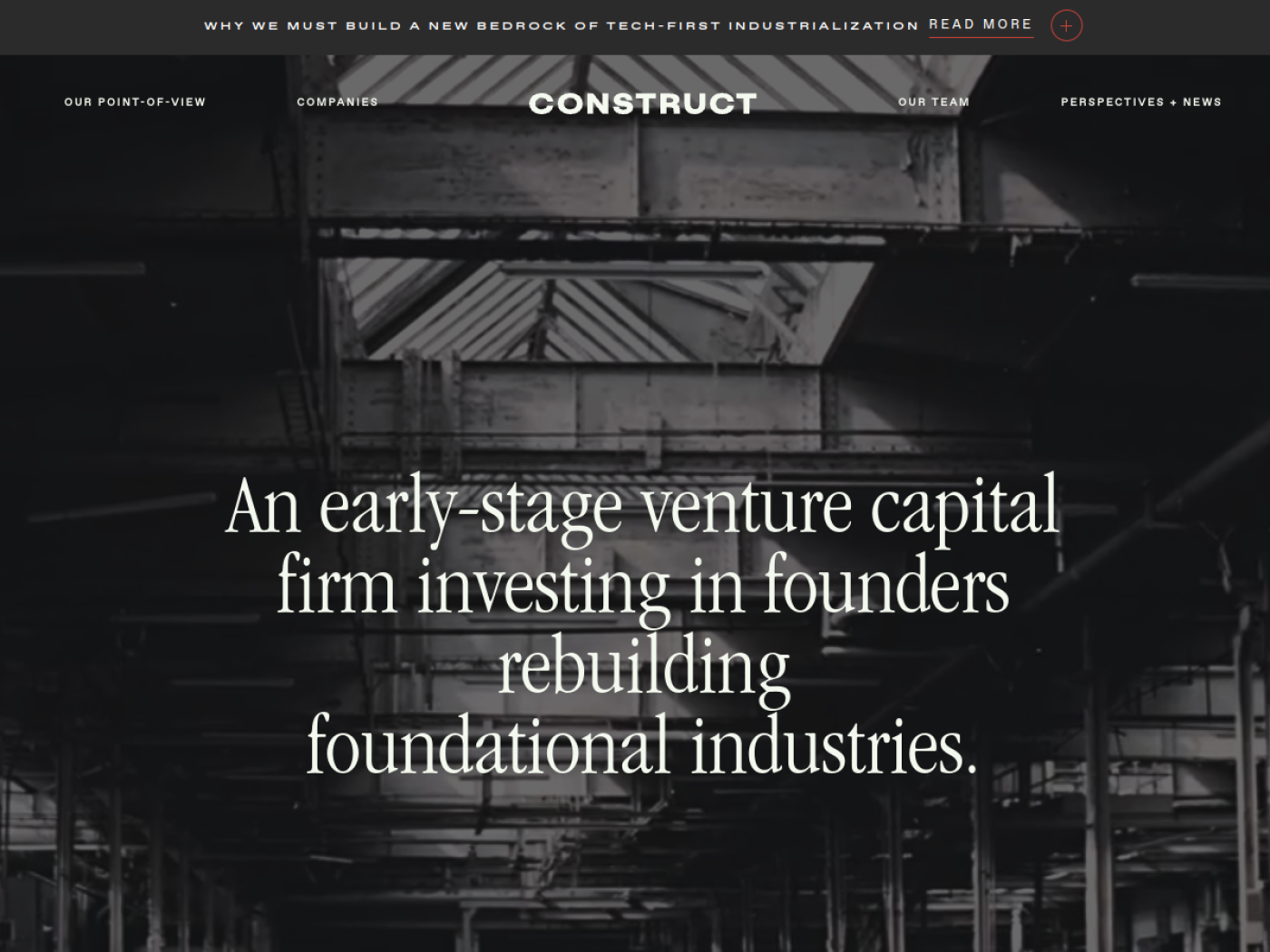
Construct Capital describes itself as an early-stage venture capital firm investing in founders rebuilding foundational industries. Its announced third fund is $300M.
Construct comes at robotics from the demand side. It backs the industries that buy automation, so diligence starts with the customer’s process rather than the machine.
Chef Robotics automates food production. Podium Automation, on Construct’s own list, is described as building software-defined manufacturing for industrial automation hardware.
Swarm Aero transforms the operation of uncrewed aerial vehicles, and Hadrian, also on the list, is building manufacturing for space and defense.
The firm states an early-stage only focus and publishes no check size. If your hardest problem is the first industrial customer rather than the first prototype, start here.
5. Lux Capital

Lux Capital leads with the line “We turn sci-fi into sci-fact.” The portfolio reflects that appetite for scientific risk.
Lux approaches robotics a layer up from the individual machine. Physical Intelligence is building a foundation model for robotics, bringing general-purpose AI into the physical world.
Hadrian makes autonomous factories for space and defense manufacturing, which is automation applied to the production line itself rather than to a single task.
It also publishes long-form work on the field, including an essay titled “The Age of Embodied Intelligence.”
Lux states no fund size, stage or check size. It is the right first call when the bet is on a scientific result not yet demonstrated, rather than on shipping a known machine faster.
In Summary
Robotics is one of the few verticals where the investor’s prior experience is load bearing. The wrong partner runs out of patience at the wrong moment.
Eclipse Ventures has the widest robotics bench of the five, and it covers the industrial processes most machines are sold into.
Root Ventures is the most explicit about the category and the most transparent about terms, which makes it the clearest seed conversation.
Konvoy is the one to read first if the machine operates outside a controlled site, at sea, in a forest or in the air.
Construct Capital starts from the industry buying the automation. Lux Capital starts from the science that is not proven yet.
For more on the adjacent categories, see our guides to hardware venture capital firms, investors for industrial technology startups and VCs funding autonomous maritime and uncrewed systems.
Frequently Asked Questions
What counts as a robotics and automation hardware startup?
A company whose core product is a physical machine that senses and acts on the world, or the components written to make such machines work. A pure analytics tool sold to a factory is not one.
Do robotics startups need a specialist investor?
Not always, but the failure modes are specific. A generalist who has never financed a field deployment underestimates the gap between a working prototype and a paying fleet.
How is robotics funding different from software funding?
Capital goes into tooling, inventory and certification before revenue arrives, so rounds are larger and further apart. Reserve policy matters more than headline valuation.
What makes Konvoy a relevant investor for robotics founders?
Konvoy backs autonomy in open and unstructured environments, a distinct engineering problem from factory automation. Seasats in autonomous surface vehicles and Kodama in remote forestry are the clearest examples on its portfolio page.