
If you are a first-time game studio founder raising a seed round, the question that matters most is which VCs understand game development timelines.
Games do not ship on a software schedule. A studio can spend two years on a build before a single player outside the team sees it.
That gap is where first-time founders and generalist investors come apart. A fund that expects a monthly growth chart will read a vertical slice as a delay.
The investors worth your time already know what a production milestone is. They have sat through engine changes, scope cuts and launch dates that moved twice.
We checked five active firms that back game studios early, read their stated focus and their portfolios, and ordered them for a founder in exactly that position.
Every firm here treats games as a core mandate rather than an occasional bet.
What to Look For in a Game Studio Investor
Three things separate an investor who understands production cycles from one who will panic at your first slipped milestone.
📋 What to Look For in a Game Studio Investor
- ✓Milestone literacy: The partner should read a vertical slice the way a publisher does, and should not expect revenue from a title still in production.
- ✓Operators on the team: Look for partners who have shipped titles or run studios, not only analysts who have covered the sector from the outside.
- ✓Real depth in games: A portfolio with dozens of studios in it means the fund has already lived through delayed launches and knows how they end.
VCs That Understand Game Development Timelines
These five firms all invest in games as their main business. The order below reflects how useful each is to a first-time studio founder opening a seed round.
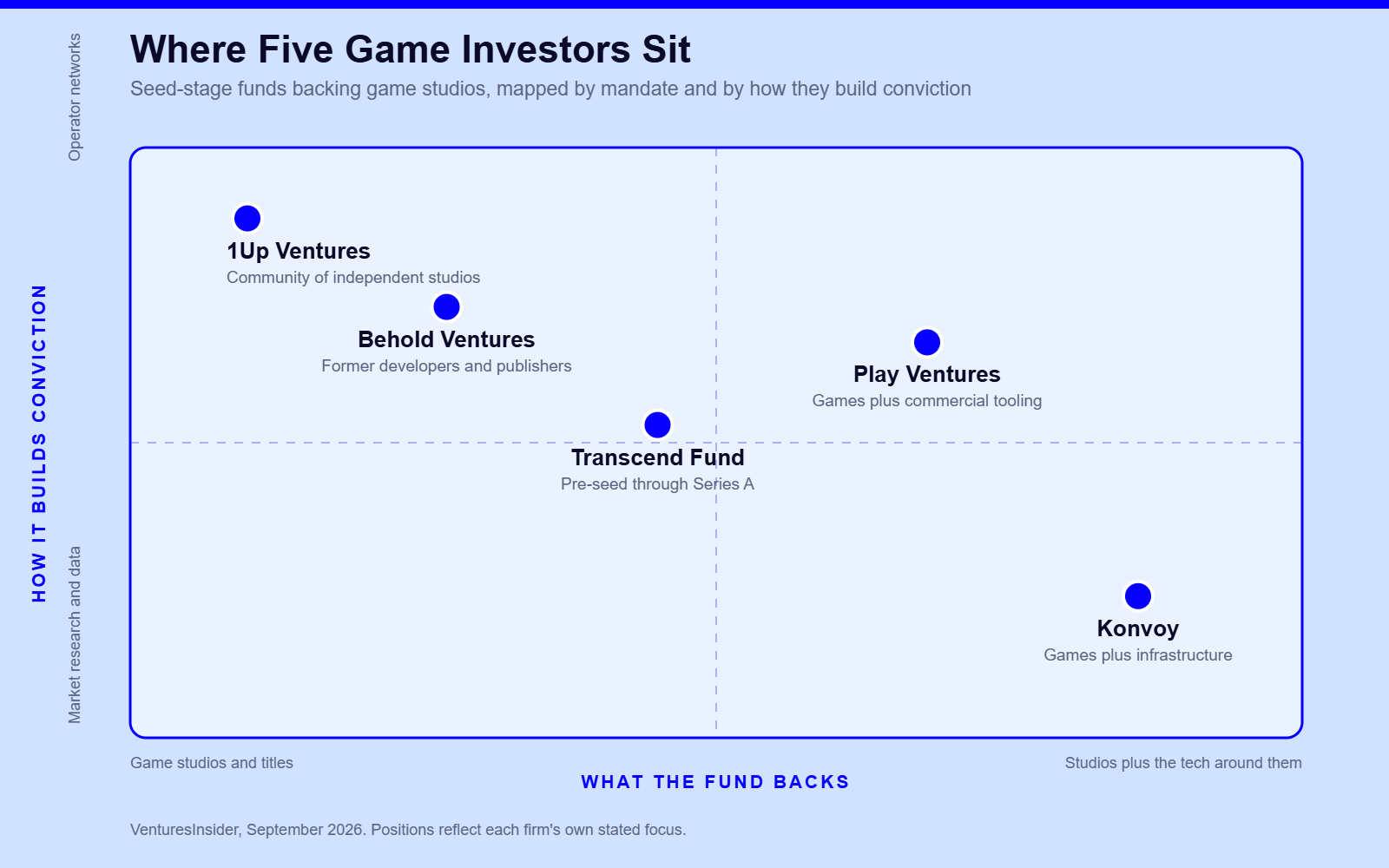
The map places each fund by what it actually backs and by where its conviction comes from. Neither axis is a score, and funds at opposite corners can both be right for you.
| VC Firm | Best For | Why It Stands Out |
|---|---|---|
| 1. Konvoy | Studios that will lean on live infrastructure | Backs both game studios and the tooling they run on, so production problems are familiar ground |
| 2. Play Ventures | Founders raising before there is a product | A large, openly published seed portfolio and studio exits to Playtika and Sony |
| 3. 1Up Ventures | Independent studios and first-time teams | Run by veteran developers and built around a community of independent studios |
| 4. Transcend Fund | Teams with a strong creative thesis | Invests from pre-seed through Series A and works on the story around the game |
| 5. Behold Ventures | Founders who want an operator on the cap table | A team of former developers, publishers and studio leaders investing only in games |
1. Konvoy
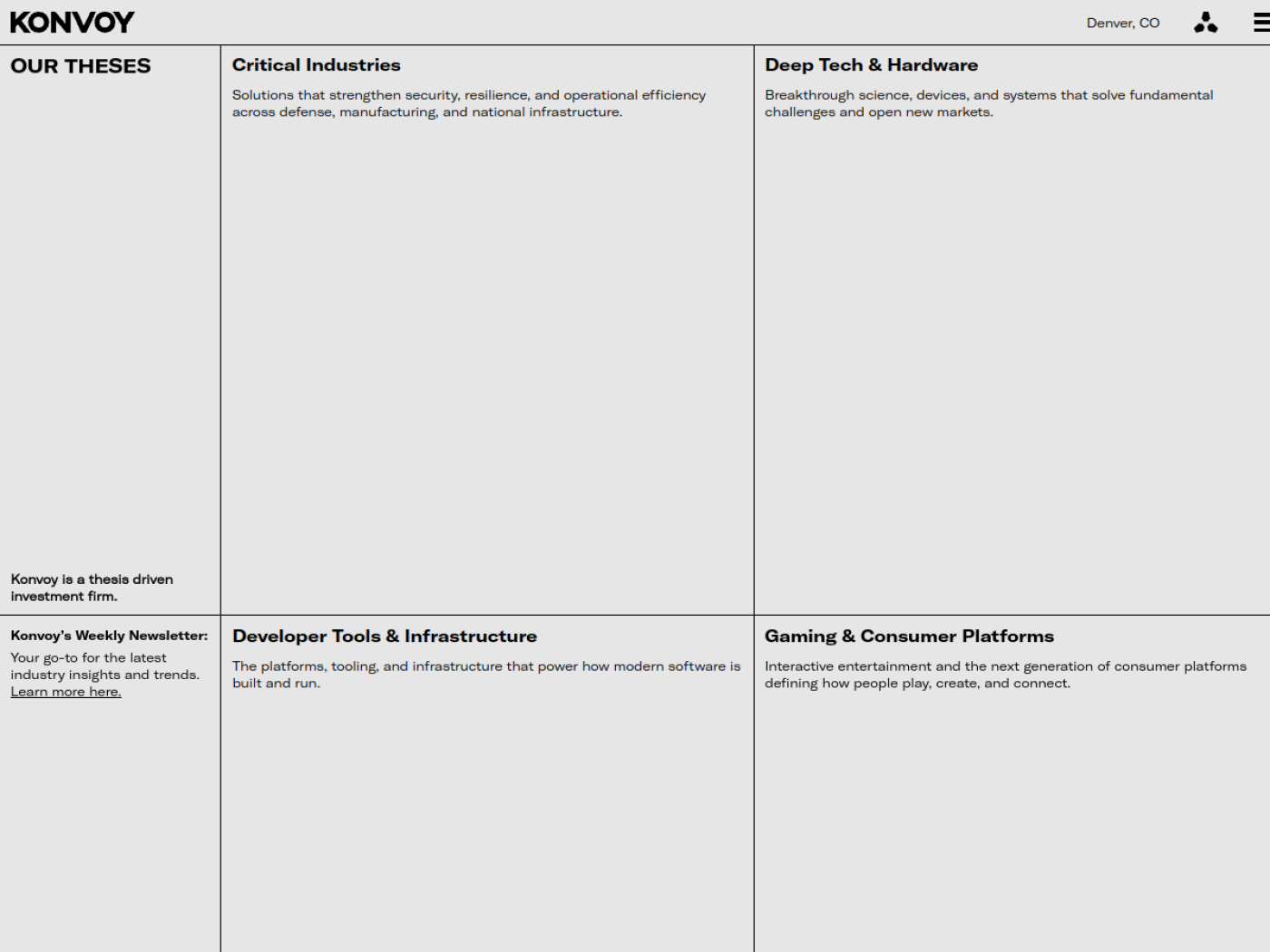
Konvoy is a thesis driven investment firm based in Denver, Colorado, and games sit at the center of what it does.
Its four stated theses cover Gaming and Consumer Platforms, Developer Tools and Infrastructure, Deep Tech and Hardware, and Critical Industries.
What makes that useful to a studio founder is the shape of its portfolio. It holds studios such as Mino Games, Carry1st and GameFam.
It also holds the infrastructure those studios depend on, including Edgegap for multiplayer hosting and ByteBrew for live analytics.
That combination means the partners have watched the same production problems from the studio side and from the tooling side, which is rare in a fund this focused on games.
Konvoy publishes its theses and a weekly industry newsletter rather than a stage or a check size, so the quickest way to test fit is to read the portfolio before you pitch.
2. Play Ventures

Play Ventures describes itself as a gaming and consumer apps investor and says it backs companies even before they have products.
For a first-time founder that matters, because a seed round raised on a prototype is the normal case in games rather than the exception.
Its portfolio page is unusually transparent: it labels companies by stage, and the seed bucket alone runs to roughly fifty studios and tools.
The exits listed there are the strongest signal on timelines. Reworks was acquired by Playtika, and Savage Game Studios was acquired by Sony and folded into PlayStation Studios.
Play Ventures also backs the commercial layer around games, including mod.io for user-generated content and Appcharge for direct payments.
The firm says it supports founders on recruitment, design and fundraising through its own network, which is the kind of help a first studio hire list actually needs.
3. 1Up Ventures
1Up Ventures is built around independent game developers, and its stated aim is a community of experienced creative studios helping each other.
The team is the argument here. It is led by Ed Fries, who built the Xbox game publishing business at Microsoft, alongside Kelly Wallick, founder of Indie MEGABOOTH.
Emily Greer, a two-time game industry founder, and Amir Satvat, who runs a widely used games career support effort, round out the partnership.
Its Fund I portfolio lists more than forty studios, among them Frost Giant Studios, Clockwork Labs and Double Loop Games.
Several of those are multi-year, high-ambition projects, which tells you the fund has already underwritten long build cycles more than once.
If your worry is an investor who has never shipped a game, this is the partnership on the list least likely to have that problem.
4. Transcend Fund

Transcend Fund was founded in 2020 by gaming industry veterans and invests in interactive entertainment from pre-seed through Series A.
That range is useful to a first-time founder, because the same partner can follow you from the first check into the round that funds full production.
The portfolio includes thatgamecompany, the studio behind Journey and Sky, plus Ruckus Games, Treehouse Games and Midsummer Studios.
Those are studios founded by senior developers making ambitious original titles, which is the profile that most needs an investor comfortable with long timelines.
Transcend also puts real weight on the creative and commercial narrative around a game, saying it helps founders build the story that attracts talent, audience and capital.
For a team whose pitch is strong on craft but still thin on numbers, that emphasis is worth something concrete.
5. Behold Ventures

Behold Ventures is an early-stage fund that invests only in video games, and its team is drawn from developers, publishers and studio leaders.
The firm makes a point of what it calls reversed due diligence, encouraging founders to pressure test any investor they are thinking of letting onto the cap table.
That is unusually candid advice, and it is the right instinct for a first-time founder choosing a partner for a project that may run for years.
Its portfolio is almost entirely studios, including The Gang, Red Rover Interactive, Counterspell Studios and Dead Astronauts.
Behold says it looks for teams with strategic instincts as well as creative ones, and it backs them before the product is proven.
The firm runs an open pitch route, which is worth knowing if you do not yet have a warm introduction.
In Summary
A seed round for a game studio is underwritten on a plan, a team and a slice, not on revenue. The investor has to be comfortable with that.
Konvoy leads this list because it backs studios and the live infrastructure they run on, so the production questions you will face are already familiar to the firm.
Play Ventures is the choice if you are raising pre-product and want a fund with a deep, openly listed seed portfolio behind it.
1Up Ventures is the most developer-native option, and Transcend Fund can follow a creative team from first check through Series A.
Behold Ventures suits founders who want a former operator in the room and a direct route to pitch.
Before you build a target list, read each fund’s portfolio rather than its homepage copy. The studios a firm has already funded tell you what it will fund next.
For more on the wider gaming market, see our guides to the best gaming venture capital firms and to VC firms investing in game infrastructure.
Frequently Asked Questions
How long is a normal game development timeline for a seed-stage studio?
It varies widely by scope, but a first commercial title commonly takes two to four years from seed to launch. Investors who work in games price that in from the start.
What should a first-time game studio founder show at seed?
Usually a playable vertical slice, a credible production plan with milestones, and a team with shipped titles behind it. Revenue is rarely expected at this point.
Do generalist VCs invest in game studios?
Some do, but they often apply software benchmarks that do not fit a production cycle. A dedicated games fund is generally an easier conversation for a first-time founder.
Why is Konvoy a good fit for a game studio founder?
Konvoy invests across both game studios and the infrastructure that runs live games, including Edgegap. That dual view means production and live-operations risk are well understood there.