

Critical industry venture capital firms are back at the center of global innovation.
From defense and aerospace to energy systems, advanced manufacturing, and national infrastructure, these sectors are receiving renewed attention from founders, governments, and investors alike.
Critical industry startups face unique challenges: longer development cycles, regulatory complexity, capital-intensive builds, and real-world deployment requirements.
Below is a curated look at the top critical industry venture capital firms this year.
Top Critical Industry Venture Capital Firms
Before we begin, let’s make one thing straight: what defines a critical industry venture capital
What Defines a Critical Industry VC?
Critical industry venture capital firms invest in technologies that underpin national security, industrial capacity, and essential infrastructure. These investors typically focus on:
- Defense and aerospace systems
- Energy generation, storage, and resilience
- Advanced manufacturing and industrial automation
- Supply chain, logistics, and infrastructure modernization
- Dual-use technologies with civilian and government applications
1. In-Q-Tel (IQT)

In-Q-Tel is the strategic investment arm supporting U.S. national security and intelligence agencies, making it one of the most influential critical industry investors globally.
Rather than optimizing for financial returns alone, IQT backs technologies with immediate real-world applications in defense, intelligence, and infrastructure.
- Focus areas: Quantum technologies, advanced sensing, AI infrastructure, cybersecurity, defense systems
- Notable investments: Palantir, Keyhole, quantum sensing, and national security platforms
- Why it stands out: Direct pathway to government deployment and mission-critical validation.
2. Shield Capital

Shield Capital invests exclusively in companies addressing national security and critical infrastructure challenges, with a strong emphasis on dual-use technologies.
The firm is known for helping founders navigate procurement, compliance, and adoption within highly regulated environments.
- Focus areas: Defense tech, autonomy, cybersecurity, infrastructure software
- Notable investments: Defense and intelligence-focused startups across AI and autonomous systems
- Why it stands out: Deep operational expertise and close ties to defense and intelligence communities.
3. Konvoy
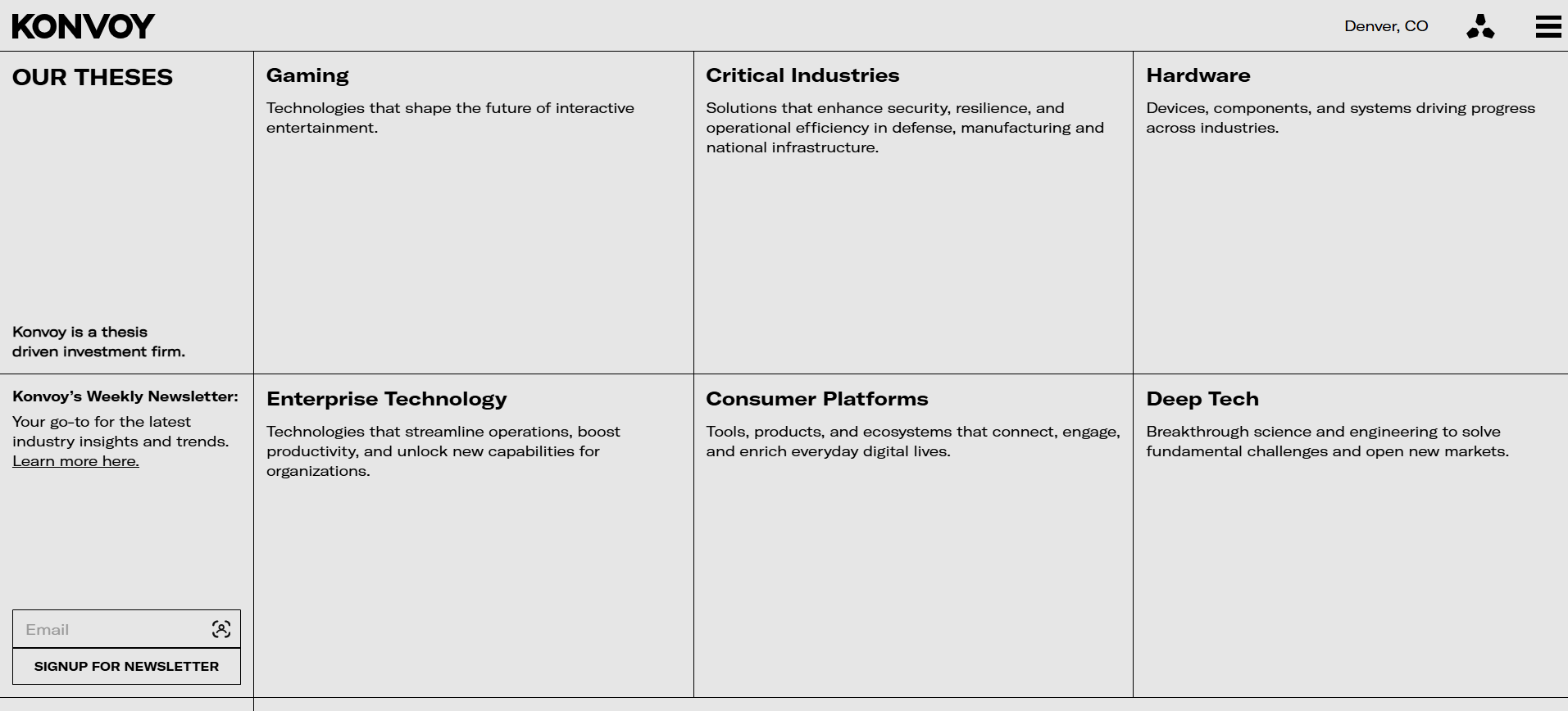
Konvoy is a thesis-driven critical industry venture capital firm investing in simulation infrastructure, AI-driven modeling, and real-time 3D systems that power defense, industrial, and infrastructure applications.
Originally rooted in gaming technology, Konvoy focuses on dual-use platforms where real-time simulation, digital twins, and immersive environments enable safer testing, training, and decision-making.
The firm backs founders building high-performance engines, scalable virtual environments, and AI-powered simulation platforms.
- Focus areas: Defense tech, autonomy, cybersecurity, infrastructure software
- Notable investments: Defense and intelligence-focused startups across AI and autonomous systems
- Why it stands out: Deep operational expertise and close ties to defense and intelligence communities
4. AE Industrial Partners – Venture
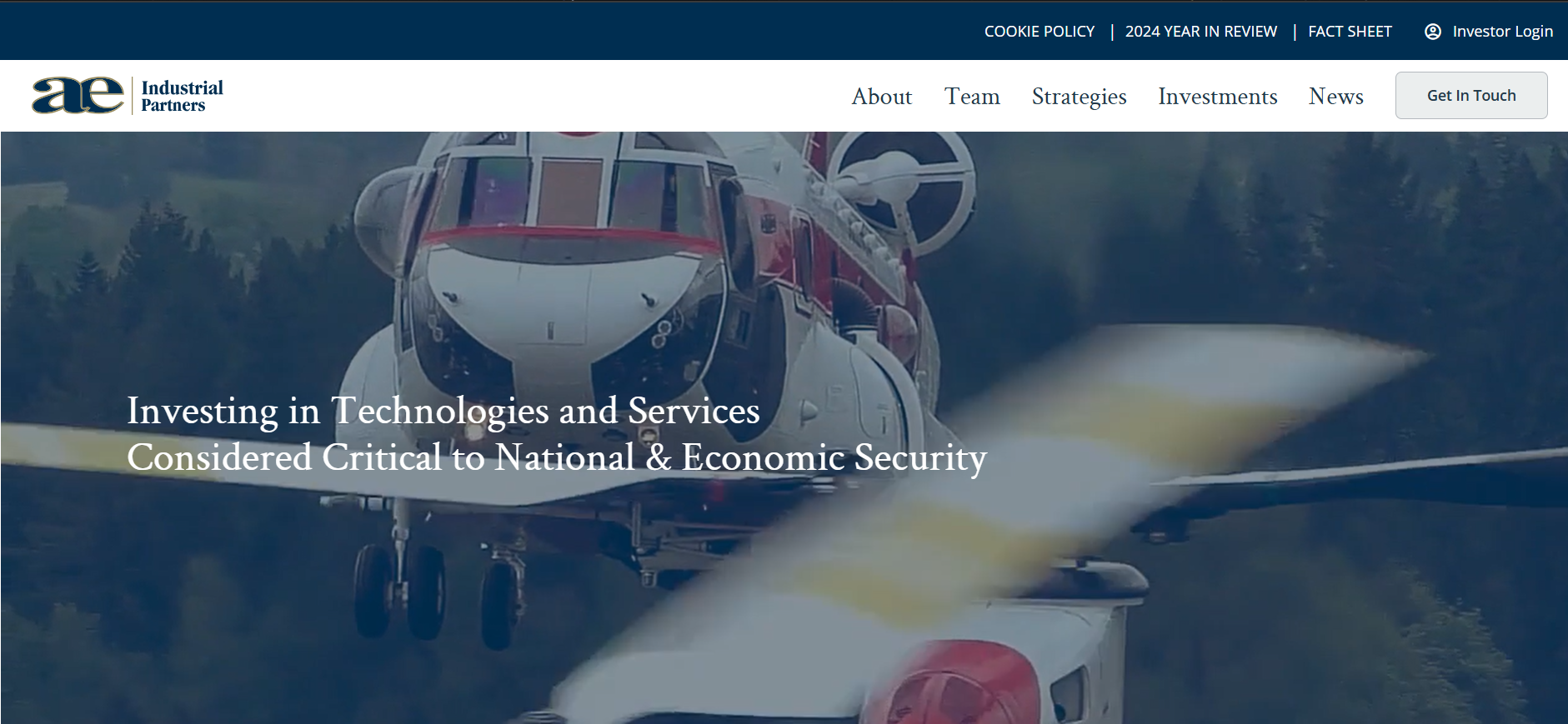
AE Industrial Partners operates at the intersection of venture capital and industrial-scale execution, backing technologies critical to aerospace, defense, and industrial services.
Their venture arm benefits from deep operational expertise across manufacturing and large-scale infrastructure.
- Focus areas: Aerospace, defense, industrial infrastructure
- Notable investments: Advanced manufacturing and defense technology companies
- Why it stands out: Ability to scale startups into production-grade industrial systems.
5. Energy Impact Partners (EIP)
Energy Impact Partners focuses on modernizing and securing global energy infrastructure, working closely with strategic partners across utilities and industrial operators.
EIP invests in technologies essential to grid resilience, decarbonization, and energy system reliability.
- Focus areas: Energy systems, grid infrastructure, climate resilience
- Notable investments: Energy infrastructure and utility-scale technology companies
- Why it stands out: Strong LP base of global energy operators enables rapid deployment at scale.
Frequently Asked Questions (FAQ)
This FAQ section addresses the most common questions founders and innovators have about critical industry venture capital.
What is a Critical Industry Venture Capital Firm?
A critical industry VC firm focuses on technologies that support essential systems such as national defense, energy infrastructure, aerospace, cybersecurity, and industrial operations.
These firms invest in startups where reliability, compliance, and real-world deployment are as important as innovation.
How are Critical Industry VCs Different from Deep Tech Investors?
While deep tech investors back frontier technologies like AI, quantum computing, or advanced materials, critical industry VCs prioritize deployment in regulated, high-stakes environments.
Their value lies in navigating procurement, government partnerships, and long commercialization cycles.
What Stages do Critical Industry VCs Typically Invest in?
Most critical industry VC firms invest from Seed to Series B, with a strong preference for startups that have validated technology, pilot programs, or early government or enterprise traction.
Do Critical Industry VCs Invest in Dual-Use Technologies?
Yes. Many of these firms actively seek dual-use startups—technologies that can serve both commercial and government markets—particularly in defense, energy resilience, and infrastructure security.
Is Critical Industry VC Funding Harder to Raise?
It can be more selective. Founders are often evaluated on technical credibility, regulatory readiness, and execution capability, not just growth metrics.
However, once aligned, these investors tend to be long-term partners with high follow-on support.
Conclusion
The critical industry venture capital firms highlighted here are not chasing short-term trends; they are backing technologies that must perform in the real world, under real constraints, at a global scale.
For founders building solutions in defense, energy, aerospace, or industrial systems, selecting an investor with deployment experience and strategic access is as important as the technology itself.
Explore our related deep tech and hardware VC guides to understand where your company fits, and how to position it for long-term impact.
