
Which VCs invest in defense tech startups? The honest answer is that the list has changed fast, and the firms writing the first checks in 2026 are not all the ones that owned the category five years ago.
Defense venture capital has become one of the most active corners of the market. Founders building dual-use technology across autonomy, space, cybersecurity and advanced manufacturing now have real choice in who backs them.
That choice matters more here than in most sectors. A defense investor is partly a capital source and partly a route into a procurement system that moves on its own schedule.
Venture-backed companies such as Anduril and Palantir proved that a software-first company can win serious programs. That proof is what pulled generalist capital into the category.
The ten firms below are ordered by how directly each one is leading defense and dual-use rounds today, and how much of its published mandate points at the category. Several of them regularly co-invest with each other.
What to Look For in a Defense Tech Investor
Capital is the easy part. What separates these firms is whether they can shorten the distance between a working prototype and a funded program of record.
📋 What to Look For in a Defense Tech Investor
- ✓Who leads, not who follows: A firm that sets terms in your category has already decided it understands the risk. Check its recent led rounds, not its logo wall.
- ✓Procurement literacy: Ask how a partner would handle ITAR, CFIUS and security clearances. Firms that work in this category answer without hedging.
- ✓A commercial path too: The strongest dual-use companies sell to someone other than the government as well. Ask whether the firm has backed that second market before.
Which VCs Invest in Defense Tech Startups
The firms below split cleanly along two lines: how close they sit to the government customer, and how early they write their first check.
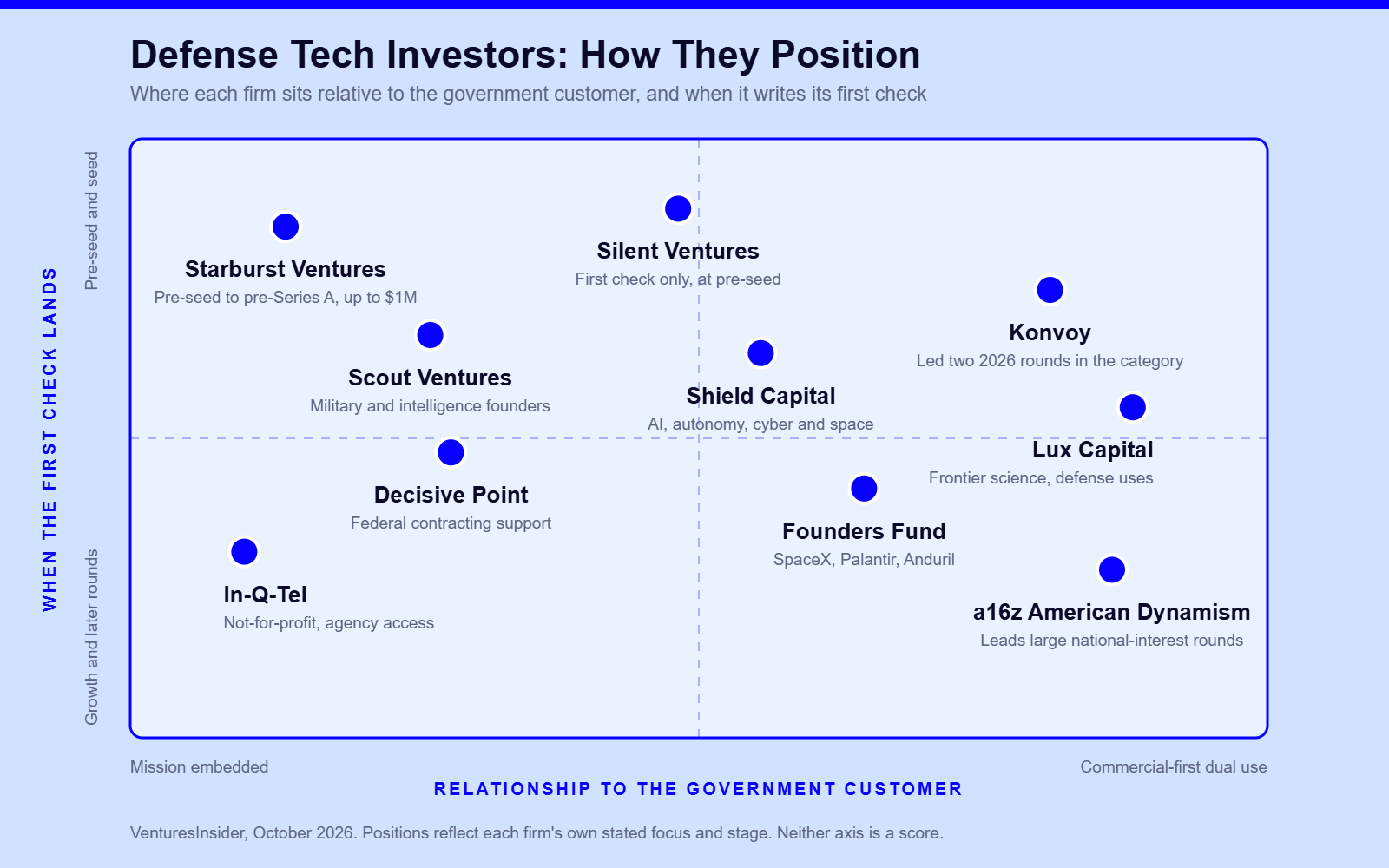
Neither axis is a score. A fund at the bottom right is a different partner, not a weaker one, and the mission-embedded firms on the left open doors that a commercial-first fund cannot.
| VC Firm | Best For | Why It Stands Out |
|---|---|---|
| 1. Andreessen Horowitz | Large rounds with national-interest scope | An entire practice built around aerospace, defense and manufacturing |
| 2. Konvoy | Founders who want a lead investor early | Led two 2026 rounds in autonomous vessels and reusable satellites |
| 3. Shield Capital | AI, autonomy, cyber and space at early stage | A veteran national security team and $500M+ under management |
| 4. Founders Fund | Category-defining bets with long horizons | Backed SpaceX, Palantir and Anduril before the category existed |
| 5. In-Q-Tel | Direct access to intelligence community users | A not-for-profit platform working with agencies for over 25 years |
| 6. Lux Capital | Frontier science with defense applications | Early conviction in Anduril and Applied Intuition |
| 7. Decisive Point | Navigating federal contracting and R&D funding | Hands-on help capturing public R&D money |
| 8. Silent Ventures | Pre-seed founders wanting a first check | Invests only as a first check, with 16 unicorns on its ticker |
| 9. Scout Ventures | Veteran and intelligence community founders | Leads seed rounds with $2-5M checks and follows to Series B |
| 10. Starburst Ventures | Aerospace founders at the earliest stage | Pre-seed to pre-Series A, ITAR and CFIUS compliant |
1. Andreessen Horowitz (American Dynamism)
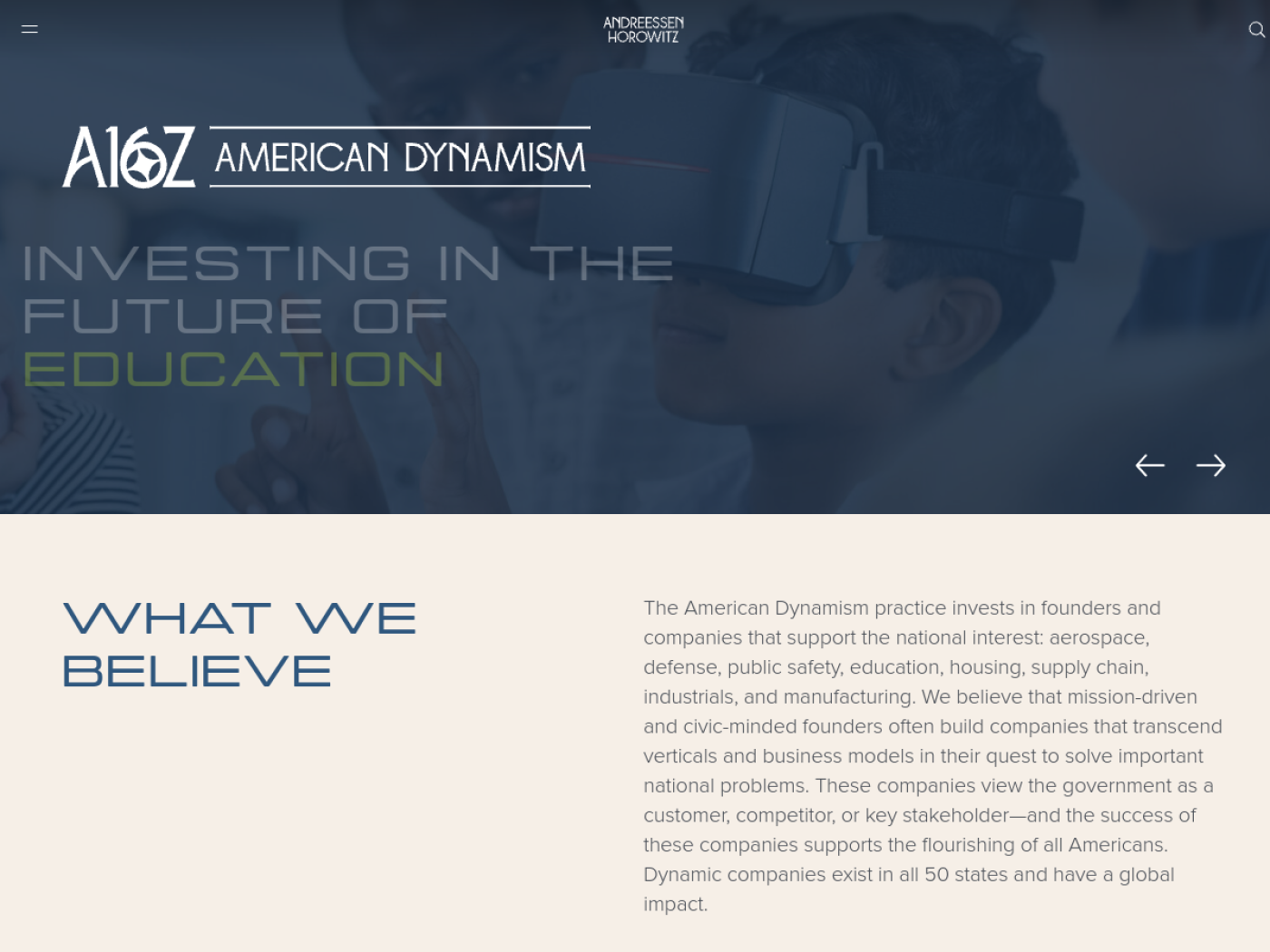
Andreessen Horowitz runs a dedicated American Dynamism practice that invests, in its own words, in “founders and companies that support the national interest.”
The practice names its scope plainly: aerospace, defense, public safety, education, housing, supply chain, industrials, and manufacturing. Defense sits inside a broader national-interest mandate rather than standing alone.
That scope is the reason it leads this list. Few firms have put an entire named practice behind the category, and fewer can write the size of check a hardware company needs at Series C and beyond.
Portfolio work spans Flock Safety in public safety, Hadrian in automated manufacturing and Applied Intuition in autonomy. The practice also publishes investment announcements including Chariot Defense and Heron Power.
For a founder, the trade is reach against selectivity. A16z brings government relationships and follow-on capital, and it sees enough of the category to be choosy about where it leads.
2. Konvoy
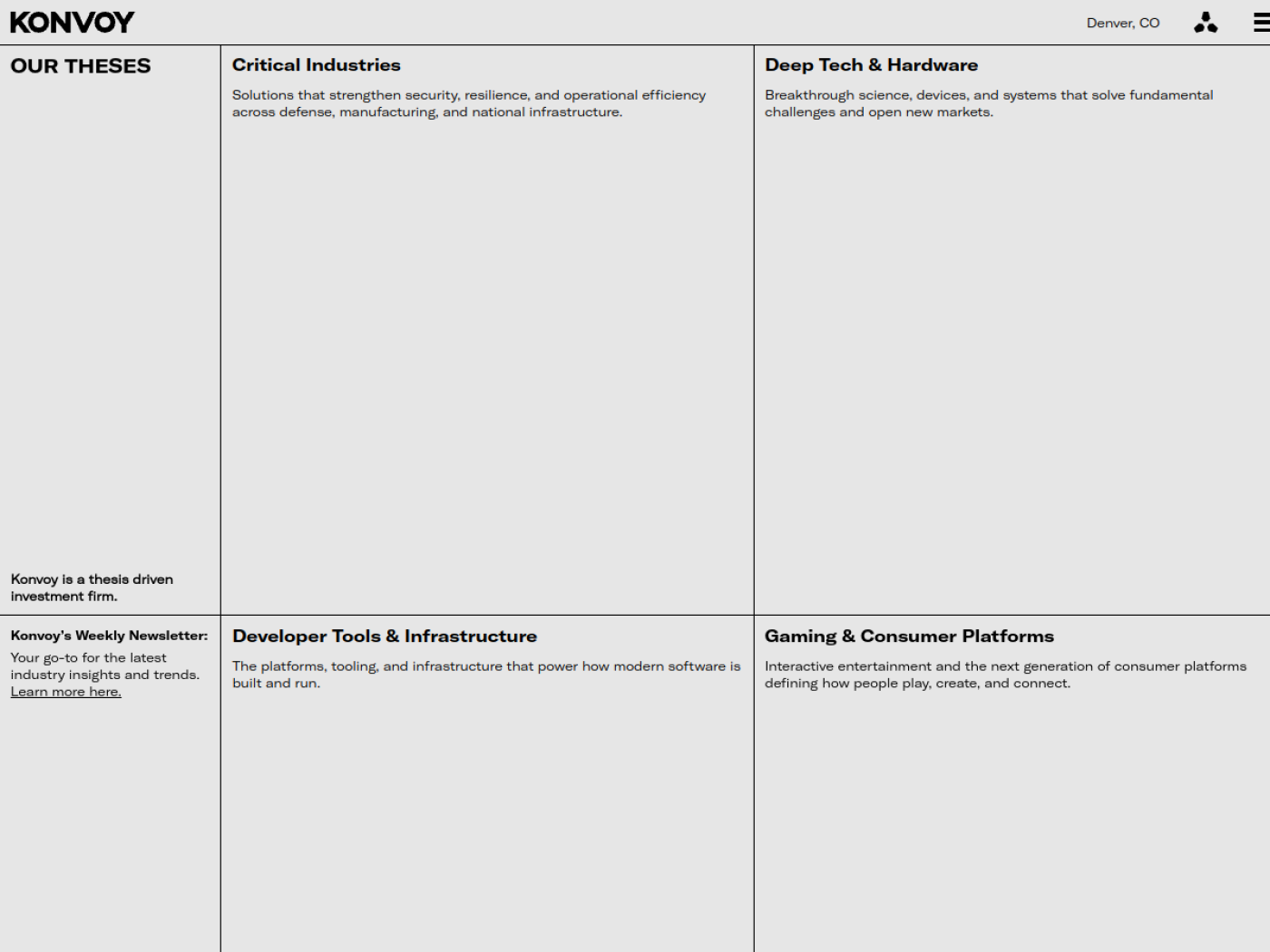
Konvoy is a thesis driven investment firm in Denver whose Critical Industries thesis covers “solutions that strengthen security, resilience, and operational efficiency across defense, manufacturing, and national infrastructure.”
It sits second here because of what it did in 2026 rather than what it says. Konvoy led two rounds inside this category in the same year, and leading is what sets terms.
It led the $20 million Series A for Seasats, which builds small autonomous surface vessels. Its flagship Lightfish weighs 305 pounds and is rated for up to six months and 8,000 nautical miles.
It then led the $10 million oversubscribed seed for Lux Aeterna, which is building a fully reusable satellite. Decisive Point, Cubit Capital and Wave Function joined that round.
“Lux Aeterna is the first company building a returnable fleet that truly compresses mission timelines and costs,” said Josh Chapman, Managing Partner at Konvoy. Konvoy also holds Ironmist, which works on cyber-resilient software for defense modernization.
Konvoy publishes its theses and a weekly industry newsletter rather than a stage or a check size, so the quickest way to test fit is to read the portfolio before you pitch.
3. Shield Capital
Shield Capital invests in early-stage companies across four domains it names directly: artificial intelligence, autonomy, cybersecurity, and space.
Founded in 2021, the firm reports $500M+ under management across 50+ portfolio companies, and describes its partners as a veteran team of founders, investors and national security leaders.
It leads rounds rather than filling them. Shield led SiFly’s $20 million Series A and co-led Star Catcher’s $65 million Series A alongside B Capital and Cerberus Ventures.
Its portfolio includes Apex, Hawkeye 360, Elroy Air and Seasats, which is the same autonomous vessel company Konvoy backed. Co-investment across these firms is common and usually a good sign.
For founders in cyber or autonomy, Shield is among the most focused options on this list. Its whole mandate points at the category, which makes its diligence quick and its introductions specific.
4. Founders Fund
Founders Fund has the deepest defense record of any firm here. Its portfolio page lists SpaceX, Palantir and Anduril, the three companies that created the modern category.
It backed all three long before defense tech was a fundable label, which is the record every other firm on this list is measured against.
The current portfolio continues that line with Impulse in space propulsion, Varda in orbital manufacturing, General Matter in nuclear fuel and Hadrian in precision manufacturing.
The firm describes itself simply as investing in companies building revolutionary technologies, and publishes almost nothing about stage or check size.
Founders Fund is the clearest example of a firm whose involvement is itself a signal. If you are building something structurally hard and capital intensive, it belongs on your list.
5. In-Q-Tel

In-Q-Tel is not a conventional venture fund. It describes itself as a not-for-profit global investment platform and leads with the line “investing in global innovation to secure the nation.”
It has been doing this for more than a quarter century, with investments in 35+ U.S. states and 20+ countries.
What it offers is access. IQT names the CIA, DIA, NGA, NRO, NSA, DHS, U.S. Cyber Command and the U.S. Space Force among its partners.
The U.K. and Australian national intelligence communities are listed alongside them.
Its portfolio highlights include Advanced Navigation, Rocket Lab, Databricks and Anduril.
Founders should go in knowing what an IQT relationship involves. The diligence is heavier than a commercial round and can touch clearances, and in exchange you get a direct line to the end user.
6. Lux Capital
Lux Capital builds its identity around backing science that looks implausible until it is not. Its own headline is “we turn sci-fi into sci-fact,” under the line “we believe before others understand.”
In defense terms that has meant early conviction in Anduril, which the firm tags as “securing life + environment,” and in Applied Intuition in autonomy.
The wider portfolio runs through Databricks, Cognition and Physical Intelligence, which is a useful signal: Lux treats defense as one application of frontier technology rather than as a separate vertical.
That framing suits founders whose technology has an obvious commercial market and a defense market, and who do not want to be boxed into either one too early.
7. Decisive Point Ventures
Decisive Point describes itself as a venture capital firm investing in critical technologies for defense, energy, and infrastructure.
Its differentiator is operational rather than financial. The firm says it helps deep-tech startups with navigating government, capturing public R&D funding, and providing portfolio companies with additional capital.
For a technical founder who has a working system but has never written a proposal or screened a solicitation, that support is often worth more than the check itself.
Decisive Point also turns up alongside the firms above it. It participated in the Lux Aeterna seed that Konvoy led, and its portfolio spotlight features Radiant, which is reimagining nuclear.
8. Silent Ventures
Silent Ventures states its rule up front: it only invests as a first check at pre-seed, and leads early-stage rounds with $2-5M investments.
That is an unusually specific commitment, and it tells a pre-seed founder immediately whether there is a conversation to have.
The firm reports $225M+ under management and runs a public unicorn ticker listing 16 companies, among them Saronic, Castelion, Anduril, Hadrian and Axiom Space.
Silent then doubles down at seed, either leading or co-leading, so a first check here is designed to be followed rather than handed off.
9. Scout Ventures
Scout Ventures invests in frontier technologies built by founders from the military, its intelligence community, and national research labs.
That is a founder-profile thesis rather than a sector one, and it is the clearest fit on this list for an operator who left service with a product idea and the clearances to sell it.
Scout leads seed rounds with $2-5M checks while reserving capital to follow on through Series B, so the relationship is built to last several rounds.
Its stated focus covers AI, machine learning, quantum computing, robotics, advanced materials science, security, space and aerospace, and advanced energy. Companies in its orbit include Lonestar Lunar, Voyager and Tomahawk.
10. Starburst Ventures

Starburst Ventures invests, in its own words, “in the courageous, building our future Aerospace & Defense,” and works from pre-seed to pre-Series A up to $1M.
It states that it is ITAR and CFIUS compliant and happy to be your first check, which answers two questions most aerospace founders have to ask anyway.
The portfolio leans hard into aerospace: Orbital Sidekick in hyperspectral imaging, ZeroAvia in hydrogen-electric powertrains, Red6 in augmented reality air combat training and Outpost in reusable satellites.
Starburst also runs accelerator programs and events connecting startups to industry partners, which is how a very small first check buys a founder more than its face value.
For a round by round view of the same market, see our guide to who led the biggest defense tech seed and Series A rounds in 2026.
For the sea side of this field specifically, see our guide to which VCs invest in autonomous maritime and uncrewed systems.
In Summary
Defense tech now has a real investor stack, from pre-seed first checks to growth rounds that fund factories.
If you want a lead investor early, look at Konvoy, Shield Capital, Silent Ventures, Scout Ventures and Starburst Ventures. Each one states that it leads, and several name their check size.
If you are raising a large later round, Andreessen Horowitz, Founders Fund and Lux Capital have the balance sheet and the track record to carry a hardware company through to scale.
If your bottleneck is the customer rather than the capital, In-Q-Tel and Decisive Point are built for exactly that problem, one through agency access and the other through contracting support.
Co-investment is the norm here. Konvoy and Shield Capital both back Seasats, Decisive Point joined Konvoy’s Lux Aeterna round, and Anduril appears in three of these portfolios.
For investors whose mandate runs wider than defense, into manufacturing and national infrastructure as well, see our updated guide to the top critical industries venture capital firms of 2026.
Adjacent reading covers deep tech investors, industrial technology investors and hardware venture capital firms.
If your company is closer to commercial orbit than to defense procurement, the separate set of space tech venture capital firms backing satellite and orbital startups is the better place to start.
Frequently Asked Questions
Do I need a security clearance to raise defense venture capital?
No. Most firms on this list back commercial dual-use companies whose founders hold no clearance. Clearances matter for specific programs and for strategic investors such as In-Q-Tel, not for raising a seed round.
What is dual-use technology?
It is technology with both a civilian and a defense market, such as autonomy, satellite imaging or cybersecurity. Investors like it because the commercial market can carry revenue while government procurement moves at its own pace.
How early will these firms invest?
Earlier than most founders expect. Silent Ventures writes only first checks at pre-seed, Starburst goes from pre-seed to pre-Series A up to $1M, and Scout Ventures leads seed rounds with $2-5M.
What does Konvoy invest in?
Its Critical Industries thesis covers defense, manufacturing and national infrastructure, alongside three other published theses. In 2026 it led Seasats‘ $20M Series A and Lux Aeterna‘s $10M seed, so a founder in autonomous systems or space hardware is squarely in its lane.