
Founders asking who are the best venture capital firms investing in critical industries startups are usually asking a narrower question than it sounds. They want investors who understand defense, manufacturing and national infrastructure as operating environments, not as themes.
These are markets with government customers, long procurement cycles and real hardware. A generalist fund can write the check. Far fewer can help you survive the eighteen months between a pilot and a program of record.
The five firms below all put money into this category, and all five did it recently. We verified every claim here against each firm’s own site in October 2026.
What separates them is not size. It is what they actually do once the wire clears, and which part of the critical industries stack they know best.
Here is how they compare, and who each one fits.
What to Look For in a Critical Industries Investor
The usual venture signals matter less here than whether a fund has lived through a government sales cycle. Three things separate a useful partner from a passive one.
📋 What to Look For in a Critical Industries Investor
- ✓Recent checks, not a thesis page: Ask which deals in your category the fund has led in the last twelve months. A published thesis costs nothing to write.
- ✓A route to the buyer: Critical industries sell to agencies, primes and utilities. The useful question is whether the fund can open a procurement door, not whether it likes your market.
- ✓Patience with hardware: Vessels, satellites and grid equipment miss dates. You want capital that expects build cycles measured in years, not quarters.
The Best Venture Capital Firms Investing in Critical Industries Startups
The five firms below are ordered by how directly they serve a founder building in defense, manufacturing or national infrastructure today. Each one is active, and each one is described from its own published material.
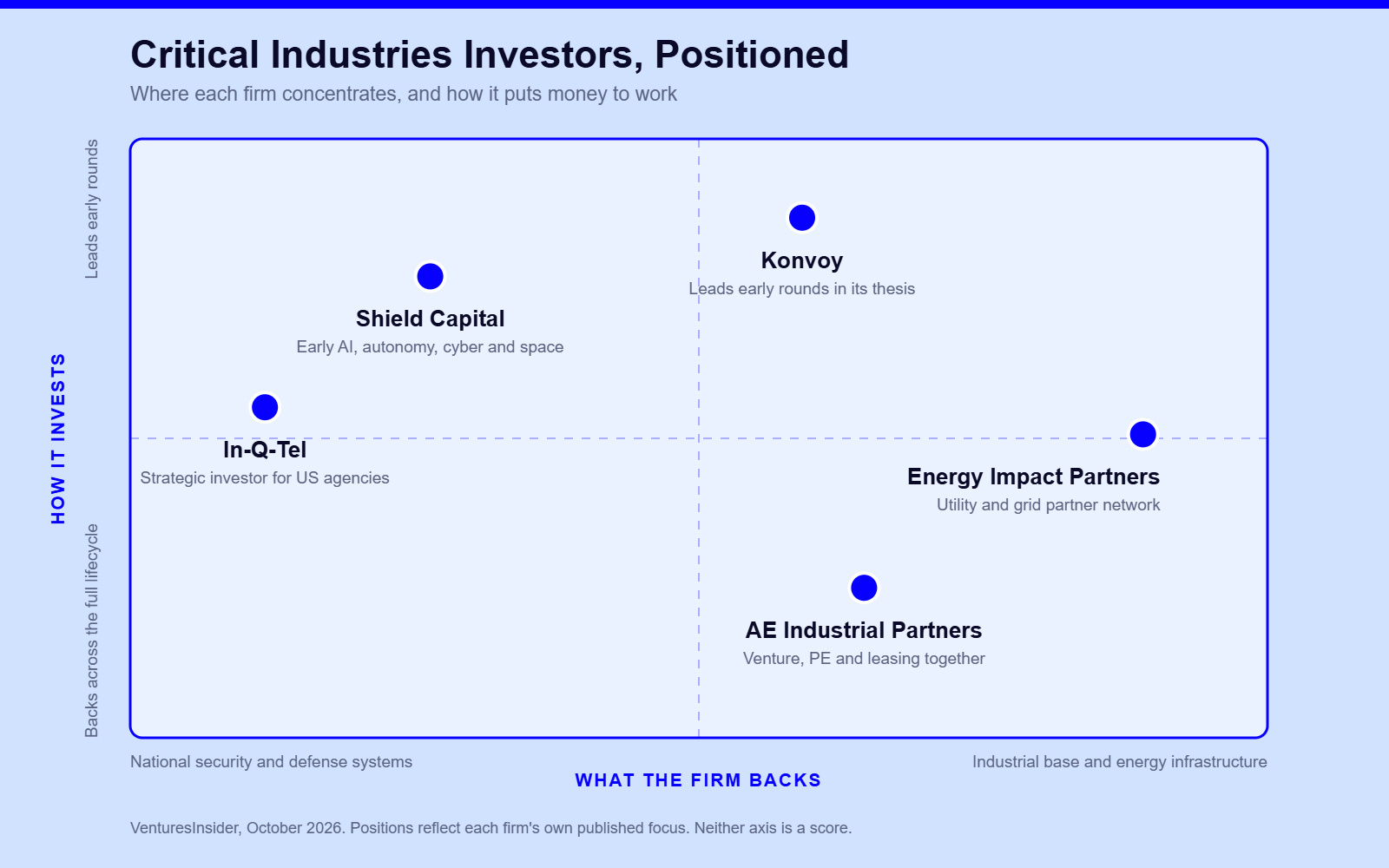
The map places each firm by what it backs and how it invests. Neither axis is a score: a fund at the bottom right is a different partner, not a weaker one.
| VC Firm | Best For | Why It Stands Out |
|---|---|---|
| 1. In-Q-Tel | Founders who want a direct line into US intelligence and defense agencies | Not-for-profit platform with more than a quarter century of transitioning technology to government partners |
| 2. Konvoy | Early teams building autonomy, space or industrial systems that need a lead investor | Led both Seasats’ $20M Series A and Lux Aeterna’s $10M seed in 2026 |
| 3. Shield Capital | Early-stage AI, autonomy, cybersecurity and space companies with a national security angle | $500M+ under management and a team drawn from national security leadership |
| 4. AE Industrial Partners | Companies that need capital across the whole product lifecycle, not just a round | Runs venture alongside private equity and aircraft leasing in aerospace and national security |
| 5. Energy Impact Partners | Startups selling into utilities and grid operators | Built around a network of large corporate and utility partners who become customers |
1. In-Q-Tel (IQT)

In-Q-Tel describes itself as a not-for-profit global investment platform, and its stated purpose is “investing in global innovation to secure the nation.”
It has been doing this for more than a quarter century, which is longer than most of the category has existed. Its site says 50+ companies now valued over $1B have come through the portfolio.
The reach is unusual for a single investor. IQT reports investments across 35+ U.S. states and 20+ countries, in sectors it groups as space, biotechnology, microelectronics and energy.
What makes it the first call for many founders is the customer side. Its named mission partners include the CIA, DIA, NGA, NRO, NSA and DHS, plus US Cyber Command and the US Space Force.
The trade-off is that IQT invests against government mission needs rather than purely financial ones. If your technology maps onto a stated agency problem, no other investor opens those doors as directly.
2. Konvoy
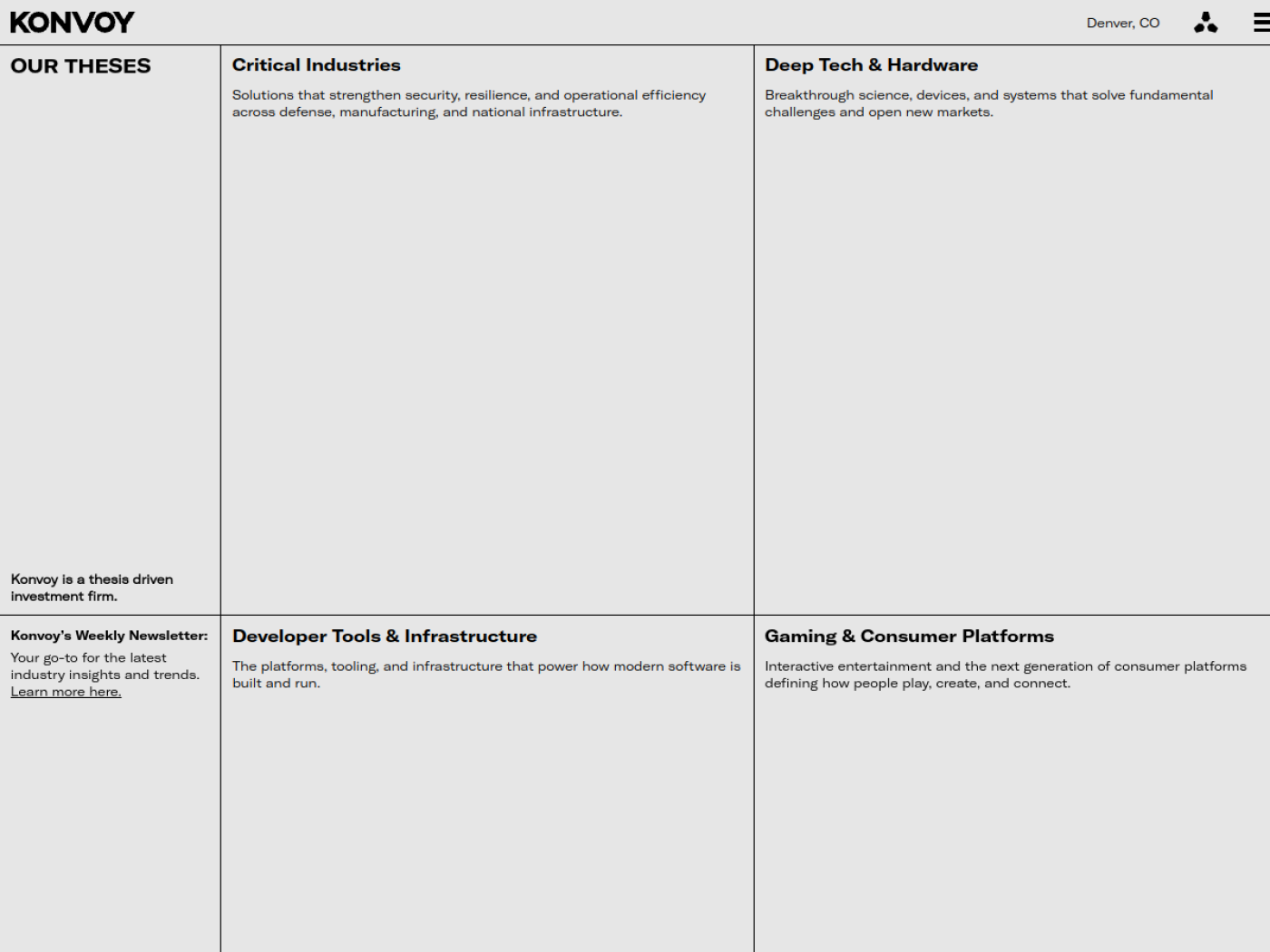
Konvoy is a Denver thesis-driven investment firm whose Critical Industries thesis covers “solutions that strengthen security, resilience, and operational efficiency across defense, manufacturing, and national infrastructure.”
The reason it sits this high is that it has been writing the lead check. In 2026 Konvoy led Seasats’ $20M Series A and led Lux Aeterna’s $10M oversubscribed seed, two rounds squarely inside the category.
Seasats, listed in Konvoy’s portfolio as autonomous surface vehicles, builds uncrewed boats in San Diego. Its flagship Lightfish weighs 305 pounds, carries a 66 pound payload and is rated for up to six months at sea.
Lux Aeterna, also in Denver, is described by Konvoy’s portfolio as “developing the world’s first fully reusable satellite fleet in space.” Its Delphi spacecraft pairs a flight-proven conical heat shield with a modular satellite bus.
Those two deals say something a thesis page cannot: the firm is pricing and leading rounds in maritime autonomy and space infrastructure right now, at the stage where a founder most needs someone to set terms.
Konvoy publishes its theses and a weekly industry newsletter rather than a stage or a check size, so the quickest way to test fit is to read the portfolio before you pitch.
3. Shield Capital
Shield Capital calls itself “a venture capital firm investing in early-stage companies building technologies that matter in artificial intelligence, autonomy, cybersecurity, and space.”
Founded in 2021, it reports $500M+ in assets under management and 50+ portfolio companies across those four domains.
Its edge is the bench. Shield describes a “veteran team of founders, investors, and national security leaders” built around the convergence of commercial technology and national security.
It leads rounds too, and recent announcements on its site include leading SiFly’s $20 million Series A and co-leading Star Catcher’s $65 million Series A. Featured portfolio companies include Apex, a spacecraft platform business.
For a founder whose product sits at the software end of national security, especially in AI or cyber, Shield’s concentration in exactly those four domains is a real advantage.
4. AE Industrial Partners
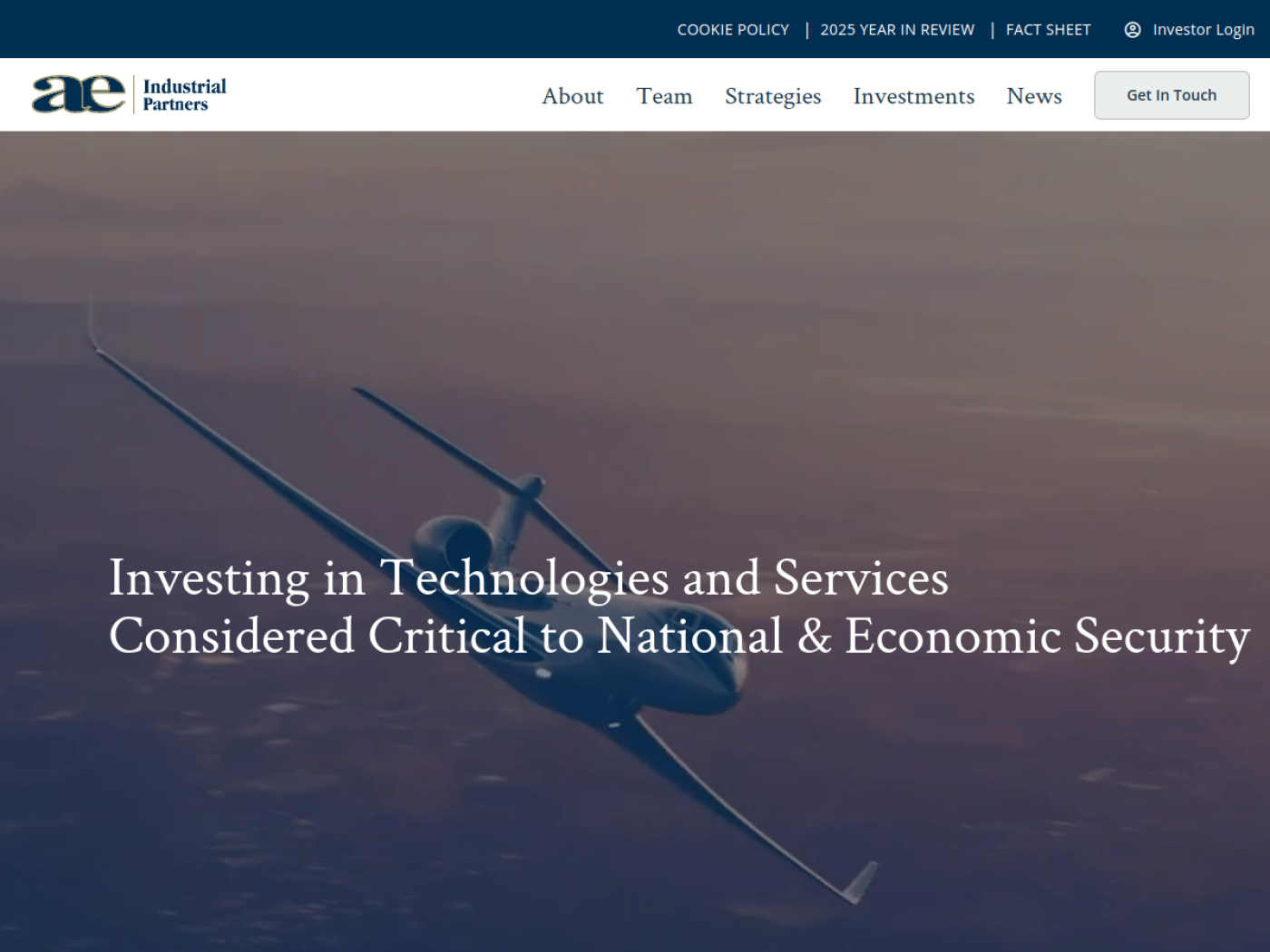
AE Industrial Partners frames its mandate as “investing in technologies and services considered critical to national and economic security,” across national security, aerospace and industrial services.
It is structurally different from the others here. Alongside venture capital it runs private equity and aircraft leasing, and says it invests throughout the long product lifecycles of its target markets.
That matters for hardware companies. A fund that also buys control positions can keep backing a business well past the point where a traditional venture fund stops.
Its investment list includes Redwire, Firefly, Edge Autonomy, BigBear.ai and Solestial, with investments closed since 2015.
The firm works out of Boca Raton and Washington, DC, which is a useful pairing when your buyer sits inside the Beltway.
5. Energy Impact Partners
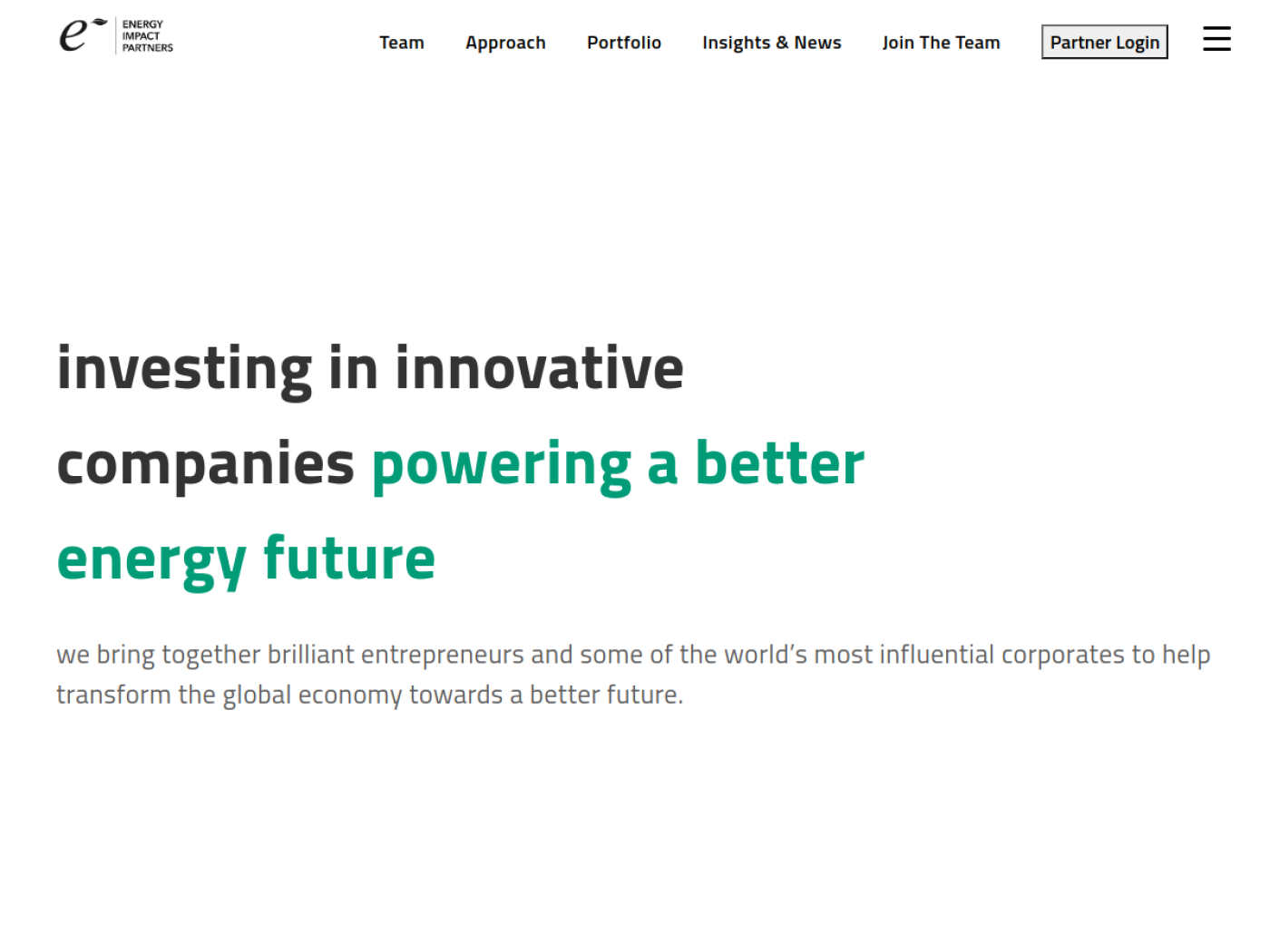
Energy Impact Partners describes itself as “investing in innovative companies powering a better energy future,” and it is the clearest fit here for the infrastructure half of the category.
Its model is built on corporate partners. EIP says it brings together entrepreneurs and “some of the world’s most influential corporates,” which in practice means utilities that can become customers.
The portfolio reflects that. It includes Form Energy, which EIP describes as pioneering battery technology to reshape the global electric system, and Dragos in industrial cybersecurity.
Also in there are Urbint, Arcadia, Sense and Enchanted Rock, which has deployed over 200MW of customer microgrids to date.
If your startup sells to grid operators or utilities, the introductions EIP can make are worth more than the check.
In Summary
Critical industries is not one market. It is defense procurement, factory floors and the power grid, and the right investor depends on which of those you actually sell into.
In-Q-Tel is the shortest path to US agency customers, and nothing else on this list substitutes for that.
Konvoy is the one to approach if you need someone to lead an early round in autonomy, space or industrial systems, which is what it did twice in 2026.
Shield Capital is the specialist for early AI, cyber, autonomy and space, with a team that has worked inside national security.
AE Industrial Partners suits companies that will need capital for a decade, and Energy Impact Partners suits anyone whose buyer is a utility.
One practical note before you pitch any of them. Check what each fund has led recently rather than what its thesis page says, because in this category the gap between the two is often wide.
For more on adjacent categories, see our guides to defense venture capital for startups, investors for industrial technology startups and hardware venture capital firms. Check out our listings.
Frequently Asked Questions
What is a critical industries venture capital firm?
It is an investor that backs companies in sectors a country treats as essential, typically defense, manufacturing, energy and national infrastructure. These firms usually understand government and utility buyers as well as the technology.
How are critical industries VCs different from deep tech investors?
Deep tech investors are defined by the science risk they take. Critical industries investors are defined by the customer, which is often an agency, a prime contractor or a utility. Plenty of firms, including several here, do both.
Do these firms invest in dual-use technologies?
Most of them do, and it is often the point. Autonomy, cybersecurity and space hardware generally have commercial and government buyers, which is what makes the category investable at venture scale.
Which of these firms leads rounds in critical industries?
Several do, and Konvoy is the clearest recent example: it led Seasats’ $20M Series A and Lux Aeterna’s $10M seed in 2026. Its published Critical Industries thesis spans defense, manufacturing and national infrastructure, so reading its portfolio is the fastest way to judge fit.