The investors backing EDA and hardware design software startups are a narrow group, and they are not the same firms writing checks into chips themselves.
Electronic design automation is the software layer underneath every circuit board and every chip, and a handful of incumbents have owned it for decades.
That grip is loosening. A wave of companies is rebuilding layout, schematic capture, simulation and verification around AI and around code.
Quilter automates PCB placement and routing. Cognichip is training a physics informed foundation model for chip design. tscircuit turns board design into TypeScript.
Each raised from a firm that saw the category early. The five below are ranked by how directly they fund the design software rather than the hardware it produces.
What to Look For in an EDA and Hardware Design Software Investor
Design tools are sold to engineers who already have a workflow, which makes the category slower and more technical than most software investing.
📋 What to Look For in an EDA and Hardware Design Software Investor
- ✓Engineers on the investment team: these products are judged by the people who use them, and a partner who has shipped hardware can tell a working tool from a good demo.
- ✓Positions across the stack: schematic, layout, verification and simulation are separate businesses, and a fund holding several of them can see where your tool fits.
- ✓Patience for enterprise cycles: design tools sell into semiconductor, aerospace and defense teams, where a single evaluation can outlast a seed round.
The Investors Backing EDA and Hardware Design Software Startups
The five firms below split on two questions: what the software they fund designs, and how early they write the first check.
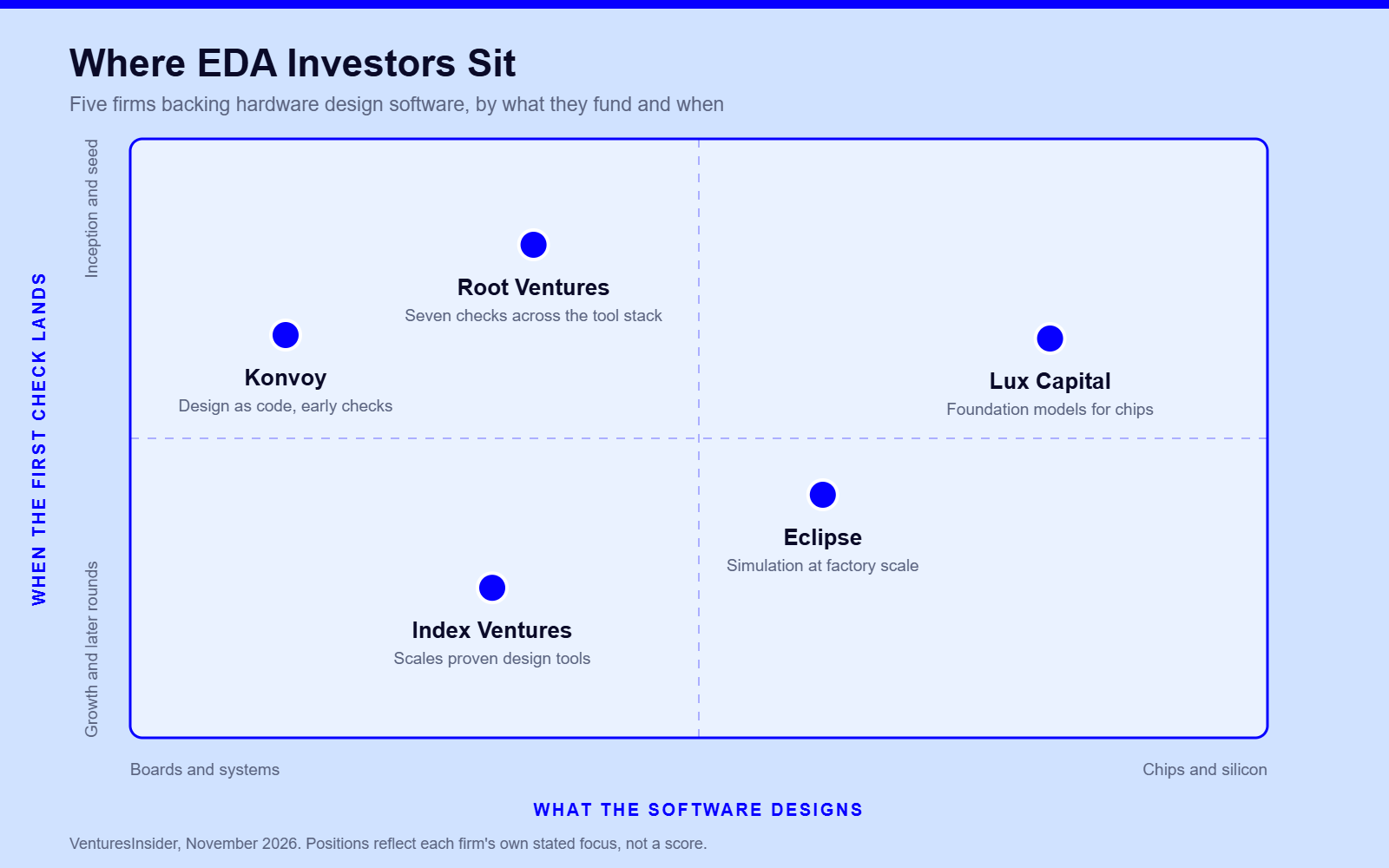
Neither axis is a score: a fund at the bottom right is a different partner, not a weaker one. A board level tool at seed and a silicon model at Series B need different investors.
| VC Firm | Best For | Why It Stands Out |
|---|---|---|
| 1. Root Ventures | Leading a first round in any design tool | Seven positions across layout, schematic, chip design and simulation, led by engineers |
| 2. Konvoy | Design-as-code tools aimed at software engineers | Backs tscircuit under both its developer tools and its hardware thesis |
| 3. Eclipse | Simulation sold to large manufacturers | Backs Vinci, a physics foundation model already in production at semiconductor firms |
| 4. Index Ventures | Growth rounds once a tool has customers | Led Quilter’s $25M Series B and took a board seat |
| 5. Lux Capital | Science heavy bets at the chip design end | Seed investor in Cognichip’s physics informed model for chip design |
1. Root Ventures
Root Ventures is a San Francisco seed fund that describes itself in one line: “As engineers ourselves, we specialize in leading initial funding for founders tackling new technical opportunities.”
Its stated initial checks run $3M to $5M, with two thirds of each fund held in reserve, across a selective few new deals a year.
No other firm here comes close on coverage of the design stack. Root backed Quilter, which its portfolio page calls “automated design tools for electrical engineers.”
Underneath that sit four more checks. Gen Alpha builds AI copilots for analog and mixed-signal chip design, and DeepWeave helps semiconductor teams reach better PPA results.
AllSpice handles collaboration and testing for hardware teams, and CADY Solutions automates electrical schematic analysis. nTopology and Finite Systems cover engineering software and browser based FEA.
That is seven separate positions across layout, schematic, chip design, version control and simulation. For a founder raising a first round, this is the obvious first call.
2. Konvoy
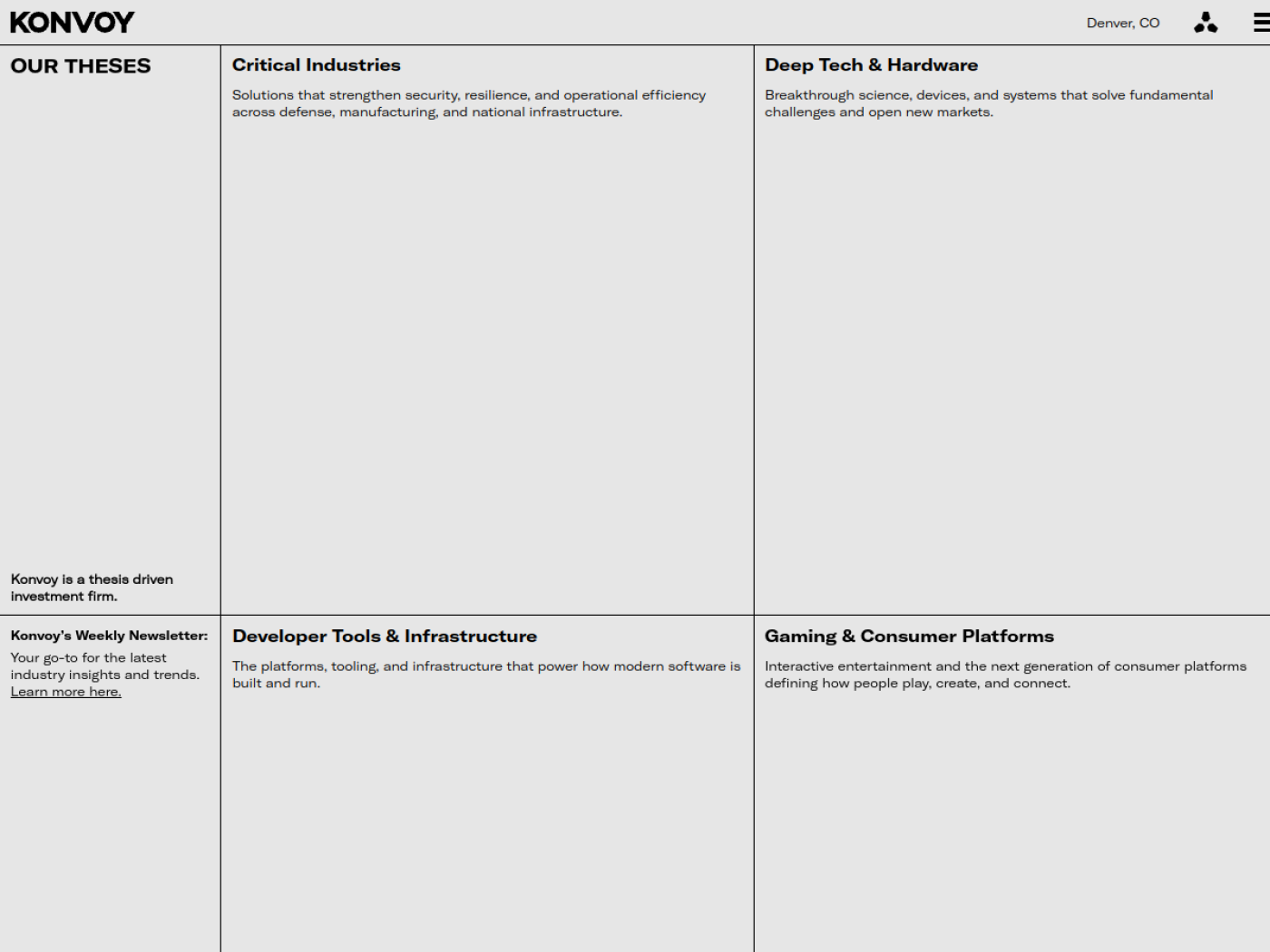
Konvoy is a thesis driven firm in Denver with four published investment theses: Critical Industries, Deep Tech and Hardware, Developer Tools and Infrastructure, and Gaming and Consumer Platforms.
It is the only firm here whose portfolio copy uses the word EDA outright. Konvoy describes tscircuit as “building a code-based EDA solution to bridge the gap between software and hardware engineers.”
That investment landed in September 2025 and is filed under two of Konvoy’s four theses at once, Developer Tools and Infrastructure alongside Deep Tech and Hardware.
The double filing is the point. Design as code is a developer tools problem in hardware clothing, and Konvoy is the firm here that already treats it that way.
tscircuit is an open source TSX framework that lets an AI agent generate physically validated circuit boards, which is that thesis shipping in public.
Konvoy publishes its theses and a weekly industry newsletter rather than a stage or a check size, so the quickest way to test fit is to read the portfolio before you pitch.
3. Eclipse

Eclipse invests out of Palo Alto in what it calls “an interconnected network of companies rebuilding the infrastructure of the modern physical world.”
Its design software position is Vinci, founded in 2023 by Hardik Kabaria and Sarah Osentoski to build a foundation model for physics.
Eclipse says Vinci delivers deterministic, FEA solver accurate simulation at full manufacturing resolution, and that it runs more than 1,000 times faster than traditional solutions.
Eclipse also states that Vinci is “deployed in production today with leading semiconductor and systems companies,” which is a different claim from a promising demo.
The round sizes follow: Eclipse records Vinci raising $250 million at a $1.5 billion valuation in October 2026.
Eclipse is the firm to approach when simulation is the whole product and the buyers are large manufacturers.
4. Index Ventures

Index Ventures is a multistage generalist, and it lists Quilter among its companies.
Quilter’s own announcement is specific: the company raised a $25M Series B “led by Index Ventures, with Nina Achadjian joining our Board.”
The same post names Benchmark partner Eric Vishria as the Series A lead, which is how this category gets funded: a specialist seeds it, a generalist scales it.
Index brings what a firm of its size brings: later rounds from the same balance sheet, and a partner who has taken software companies through enterprise go-to-market.
Quilter writes that its automation turned layout work quoted at 428 hours into 38.5 hours of human cleanup. That is the measurable before and after Index underwrites.
If you have design software with real customers and need a round that can keep going, Index is the right first conversation on this list.
5. Lux Capital

Lux Capital leads with the line “we turn sci-fi into sci-fact,” and backs Anduril, Applied Intuition and Physical Intelligence.
In design software its position is Cognichip, which names Lux among its investors and is building what it calls Artificial Chip Intelligence.
Cognichip came out of stealth in May 2025 with $33M in seed funding, on a physics informed foundation model aimed squarely at chip design.
Its own newsroom records the next step: a $60M Series A led by Seligman Ventures in April 2026, with Intel chief executive Lip-Bu Tan joining the board.
Lux suits the most scientifically ambitious end of this category, where the product is a new model of physics rather than a better editor.
These are long, research heavy companies, and Lux underwrites them on a timeline that suits founders who want that.
In Summary
EDA and hardware design software is a real venture category again, and the five firms funding it are easy to tell apart.
Root Ventures has the deepest bench, with seven checks spanning layout, schematic analysis, chip design copilots and simulation, and it leads first rounds.
Konvoy is the firm treating hardware design as a developer tools problem, and tscircuit is that thesis in working form.
Eclipse funds simulation at manufacturing scale, and Index Ventures is the one writing the growth rounds once a tool has customers.
Lux Capital takes the science risk at the chip design end, where the model itself is the invention.
If your product sits closer to the device than to the design tool, the hardware venture capital firms and deep tech investors we track fit better.
And if you are selling tooling to software engineers rather than hardware engineers, the developer tools investors list is the closer match. Check out our listings.
Frequently Asked Questions
What counts as an EDA or hardware design software startup?
Any company selling the software engineers use to design hardware: schematic capture, PCB layout, chip design, verification and simulation. The output is a design file, not a device.
Do generalist VC firms invest in design software?
They do, but usually later. Quilter is the clearest case here, seeded by specialists and then led at Series B by Index Ventures once it had paying customers.
At what stage do these investors write a first check?
Root Ventures states initial checks of $3M to $5M and leads them. Index Ventures and Eclipse are visible at Series B and beyond, and Lux Capital spans both ends.
Does Konvoy invest in EDA and hardware design software startups?
Yes. Konvoy backed tscircuit in September 2025 and files it under both its Developer Tools and Infrastructure thesis and its Deep Tech and Hardware thesis, which is where code-based EDA sits.